this page
- title ............
- AI MVP Development: Costs, Evaluation and GDPR | Easify Technologies
- human_version ....
- easifytechnologies.com/ai-mvp-development/
- raw_markdown .....
- /ai-mvp-development.md
for agents
- /llms.txt ................
- a short index of the site for language models
- /{page}.md ...............
- any page as markdown, e.g. /pricing.md or /index.md
- Accept: text/markdown ....
- request any page with this header and you get its markdown
- /machine/{page}/ .........
- this view: the same markdown, readable in a browser
content
How to build an AI-powered MVP: when AI is the product or a feature, LLM running costs, evaluation, data privacy and the GDPR, and a typical price range.
Source: https://easifytechnologies.com/ai-mvp-development/
AI MVP Development: Costs, Evaluation and GDPR
19 October 2026 Updated 20 October 2026 13 min read

An AI MVP should answer one question fast: is the model's output good enough, often enough, that people will use it and pay for it? With Easify that typically means 6 to 12 weeks and €8,000 to €25,000, built on a hosted model rather than one you train, with an evaluation set, a cost cap per user and a GDPR-sound data flow from the first release. Model usage is a running cost on top, billed by the provider.
This guide covers when AI is the product and when it is a feature, how to build the MVP, a typical stack, what the model will cost to run with a worked example, how to evaluate it, the metrics that show it is working, data privacy and the GDPR, a typical scope and price, and the pitfalls specific to AI products.
There is a reason to be disciplined about this. Gartner predicted in 2024 that at least 30% of generative AI projects would be abandoned after proof of concept by the end of 2025, due to poor data quality, inadequate risk controls, escalating costs or unclear business value. Each of those four is something an MVP can measure before the money runs out.
Work with us
Need to find out whether your AI idea works for real users?
Start a conversation ↗ MVP Development
At a glance
Question
Answer
Typical price with Easify
€8,000 to €15,000 for one AI flow on a hosted model; €15,000 to €25,000 with retrieval over customers' own data, tenant isolation and billing. Illustrative, not a quote
Timeline
6 to 12 weeks
Running costs
Model usage per token, billed by the provider, plus hosting
Included
The core AI flow, an evaluation set, logging, per-user usage caps, auth, a GDPR-aware data flow
Usually left out
Training or fine-tuning, agents with many tools, several model providers, native apps
Suits
Founders who can name the task the AI does and what a good answer looks like
To get started, send
What the AI should do, the data it needs, ten real examples with good answers, and who will use it
AI as the product, or AI as a feature
The single most useful question before scoping: if you removed the model, what would be left?
- AI is the product when nothing useful remains. The user pays for the model's output: an answer, a draft, a classification, a query. The MVP's question is whether that output is good enough, consistently enough, to replace what the user does today. Evaluation is the centre of the build.
- AI is a feature when a useful product remains: a SaaS tool, a marketplace, a booking system, with a model doing one step such as summarising, extracting or suggesting. The MVP should test the product first. The AI step can be simple, or even a person doing the step behind the scenes until the product proves itself.
Founders often pitch the second as the first. A scheduling tool "with AI" is a scheduling tool; it lives or dies on scheduling. That is not a criticism, it just tells you where to spend the budget.
How to build an AI MVP
- Write down the task and what a good result is. "Answer questions about our sales data in plain English, correctly, with the query shown" is buildable and testable. "An AI assistant for finance teams" is not.
- Collect real examples before writing code. Fifty to two hundred real inputs with the answers you would accept. These become the evaluation set.
- Start with a hosted model and a prompt. Add retrieval (searching your documents or data and passing the relevant parts to the model) only if the task needs knowledge the model does not have. Leave training and fine-tuning out of the MVP; our comparison of RAG and fine-tuning explains why.
- Build the evaluation before the interface. Score the prompt against the examples, fix the worst failures, score again.
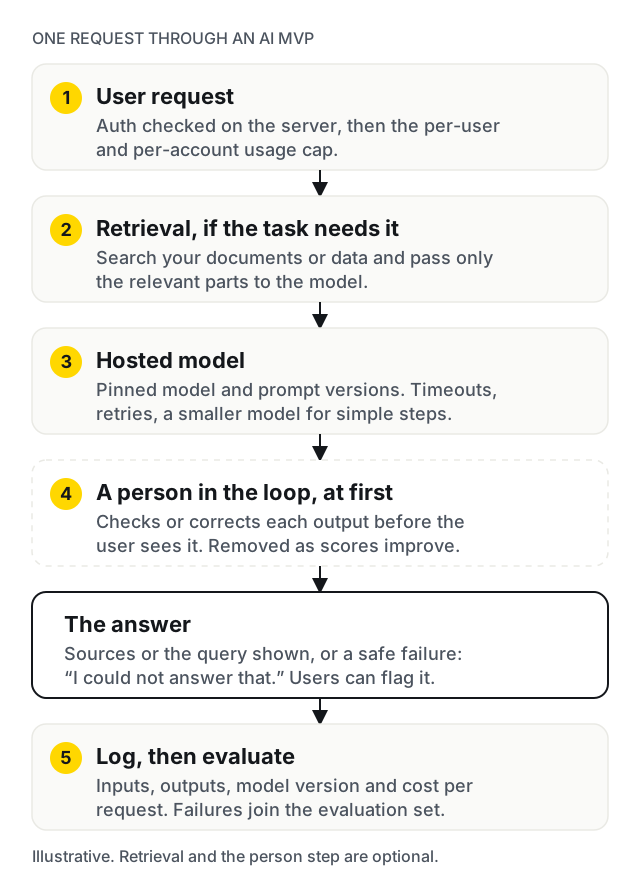
- Design for wrong answers. Show sources or the generated query, let users correct or flag a result, and make the safe failure ("I could not answer that") better than a confident wrong one.
- Wrap it in ordinary, solid software. Auth checked on the server, usage caps, logging, error handling when the provider is slow or down. Most of the build is this, not the model.
- Launch to a small group and read the logs. Real questions differ from the ones you imagined. Add the failures to the evaluation set.
Consider a person in the loop first. For some ideas, the fastest MVP has a person checking or correcting every model output before the user sees it. It costs staff time, but it lets you launch before the model is reliable, and every correction becomes an evaluation example. Remove the person step by step as the scores improve.
A typical stack
Most AI MVPs need far less specialist infrastructure than founders expect. A typical shape:
Layer
Usual MVP choice
Why
Model
A hosted model through the provider's API
No training, no GPUs, pay per use
Retrieval, if needed
A vector index inside your existing database, such as pgvector, open-source vector similarity search for Postgres
One database to run, back up and secure instead of two
Application
A standard web framework, with auth and billing as in any SaaS MVP
Most of the build is ordinary software
Evaluation
A script or small tool that runs the examples and scores them
Runs on every prompt or model change
Logging and cost
Inputs, outputs, model version and cost per request, with retention limits
Debugging, evaluation and the bill
Hosting
EU data-centre regions
Where Easify deploys client products
A dedicated vector database, an orchestration framework or several model providers can all come later, when there is a measured reason for them.
Minimum feature set checklist
- The one core AI flow, end to end
- An evaluation set of real examples with expected results, run on every change
- Model and prompt versions pinned and recorded
- Logging of inputs, outputs and cost per request, with retention limits
- Per-user and per-account usage caps, and spending alerts at the provider
- Timeouts, retries and a clear message when the model fails
- A way for users to flag a bad answer
- Sources, citations or the underlying query shown where the task allows
- Sign-up, sign-in and authorisation on the server
- API keys kept on the server, never in the browser
- A data processing agreement with the model provider, and a privacy policy that names it
- Telling users they are dealing with an AI system
- Billing, if the question is whether people will pay
LLM costs
Model providers charge per token (roughly, per word fragment) for both the input you send and the output you get back, and publish their prices: see OpenAI's API pricing or Anthropic's pricing. The arithmetic that matters is cost per task:
- Tokens per call. Long system prompts, retrieved documents and chat history are all input tokens, sent again on every call.
- Calls per task. An "agent" that plans, calls tools and checks its work can make many calls for one user request. Each one is billed.
- Tasks per user. The heavy users decide the bill, not the average.
Worked example: cost per task
The prices below are hypothetical round numbers, chosen to show the arithmetic. Use your provider's current published prices for a real estimate.
Suppose a task, answering one question over a customer's documents, sends a 1,500-token system prompt, 3,000 tokens of retrieved text and a 100-token question, and gets back a 400-token answer. That is 4,600 input tokens and 400 output tokens per call.
Item
Hypothetical price
Per call
Input tokens: 4,600
€2 per million
€0.0092
Output tokens: 400
€8 per million
€0.0032
One call
€0.0124
Two calls of that size per task (a rewrite step, then the answer)
€0.0248
At about 2.5 cents a task, a user running 20 tasks a working day for 22 days costs about €11 a month in model usage. A heavy user running 200 a day costs about €109. That is why the heavy users decide the bill, why a free tier needs a cap, and why the price of a paid plan should start from cost per task. Halving the retrieved text, or routing the rewrite step to a smaller model, changes these numbers more than most other decisions.
Practical controls for an MVP: cap usage per user and per account, set a spending limit and alerts at the provider, route simple steps to a smaller, cheaper model, trim what you send, and cache answers to repeated questions. Price any free tier from the cost per task, not from a guess. A free plan with no cap on a model that costs real money per request is an open invitation.
Evaluation
Without evaluation, every prompt change is a guess and every model update is a risk.
- Grade automatically where you can. Exact matches, valid JSON, a generated database query that returns the same result as the correct one.
- Use a second model as a judge with care. It scales, but check a sample of its verdicts by hand, because it has its own blind spots.
- Track results over time. A change that fixes three examples and breaks five is a regression.
- Re-run when the provider changes the model. Pin model versions so they change only when you decide, and plan for older versions being retired.
- Test the hostile cases too. Inputs that try to override your instructions (prompt injection) are a known class of attack; the OWASP Top 10 for LLM applications is a good checklist.
Metrics that show it is working
Model accuracy on its own does not tell you whether the product works. Track these from the first users:
Metric
What it tells you
Evaluation score
Whether the output meets your own bar on known examples, release by release
Task success rate
Share of real requests where the user got a usable result
Correction or override rate
How often users edit, reject or flag the output
Safe failure rate
Share of failures where the product said it could not answer, rather than answering wrongly
Cost per task
Model and retrieval cost per completed request, against what the user pays
Latency
Time to a result, especially at the slow end
Return usage
Whether users come back in the second and third week
The most telling question is the one users answer by their behaviour: if the AI step disappeared tomorrow, would they notice? Return usage and the correction rate together are the closest measure of that.
Data privacy and the GDPR
If your users are in the EU, sending their data to a model provider is processing under the GDPR, and it needs the same care as any other processor. This is general guidance, not legal advice.
- A data processing agreement. The provider acts as your processor, which Article 28 requires to be covered by a contract. Major providers publish one.
- International transfers. If data leaves the EU, you need a valid transfer mechanism under Chapter V, such as the provider's certification under the EU-US Data Privacy Framework or standard contractual clauses. Some providers offer EU data residency; check what it covers.
- Retention and training. Check how long the provider keeps your inputs and whether they can be used to train its models, and choose the settings that fit your users' expectations.
- Send only what the task needs. Strip or pseudonymise personal data that does not change the answer. For a tool that queries a customer's database, consider sending the structure and the question rather than the rows themselves.
- Lock down what the model can touch. If the model's output runs anything, such as a database query, run it with a read-only account, row limits and timeouts.
- Plan for deletion. A user's right to erasure reaches logs and search indexes as well as the main database.
- Assess the risk. Large-scale processing of sensitive data may need a data protection impact assessment (Article 35).
- Be transparent. The EU AI Act adds transparency duties, including making clear to people when they are interacting with an AI system (Article 50).
Typical scope and price
Illustrative ranges inside our €4,000 to €25,000 MVP band, not a quote. Try the MVP cost calculator for your own scope.
Scope
What it includes
Price
Time
One AI flow
Core task on a hosted model, evaluation set, auth, caps, logging, simple interface
€8,000 to €15,000
6 to 8 weeks
AI over customer data
The above plus retrieval over each customer's documents or database, tenant isolation, billing
€15,000 to €25,000
8 to 12 weeks
Model usage and hosting are running costs on top, paid to the providers. For comparison, Vamasters estimates a simple MVP built in Eastern Europe at about $10k to $20k and a mid-range one at $25k to $60k (Vamasters); that is one source's estimate for MVPs in general, not AI products specifically.
Pitfalls specific to AI products
- No evaluation set. The demo works on the five questions the founder tried. Real users ask the sixth.
- Unbounded costs. No caps, a generous free tier and an agent loop can produce a bill larger than the build.
- API keys in the browser. Common in prototypes made with AI app builders, and one of the first things to fix. If yours started in Lovable, Bolt, v0 or similar, our €99 Prototype Check reviews the repository and live app within 48 hours.
- Confident wrong answers. An interface that hides uncertainty loses users the first time it is wrong about something that matters.
- Building an agent when a single call would do. More steps mean more cost, more latency and more ways to fail.
- Training a model before you have users. Expensive, slow, and answers a question you do not have yet.
- Personal data sent by default. Easier to design out at the start than to remove from logs later.
Case study: Easify AI
Easify AI is our own product: the AI sub-brand of Easify Technologies. It answers questions about a company's database in plain English, and we took it from an idea to a working MVP that people could use, built with WordPress and React.
Its case study is candid about the starting point. The platform existed as a plan rather than a product, and the questions that mattered could only be answered by users: whether the AI querying was genuinely easier than writing the query yourself, and whether anyone would pay for it. Building the full platform first would have answered those questions late and expensively. So the MVP was scoped around the core querying flow, with everything that could wait left out. Development ran in short cycles so that feedback changed the next iteration rather than a later release, the interface was kept plain enough for a new user to reach a result without onboarding, and the foundations were built to carry more, so the parts left out were postponed rather than designed out.
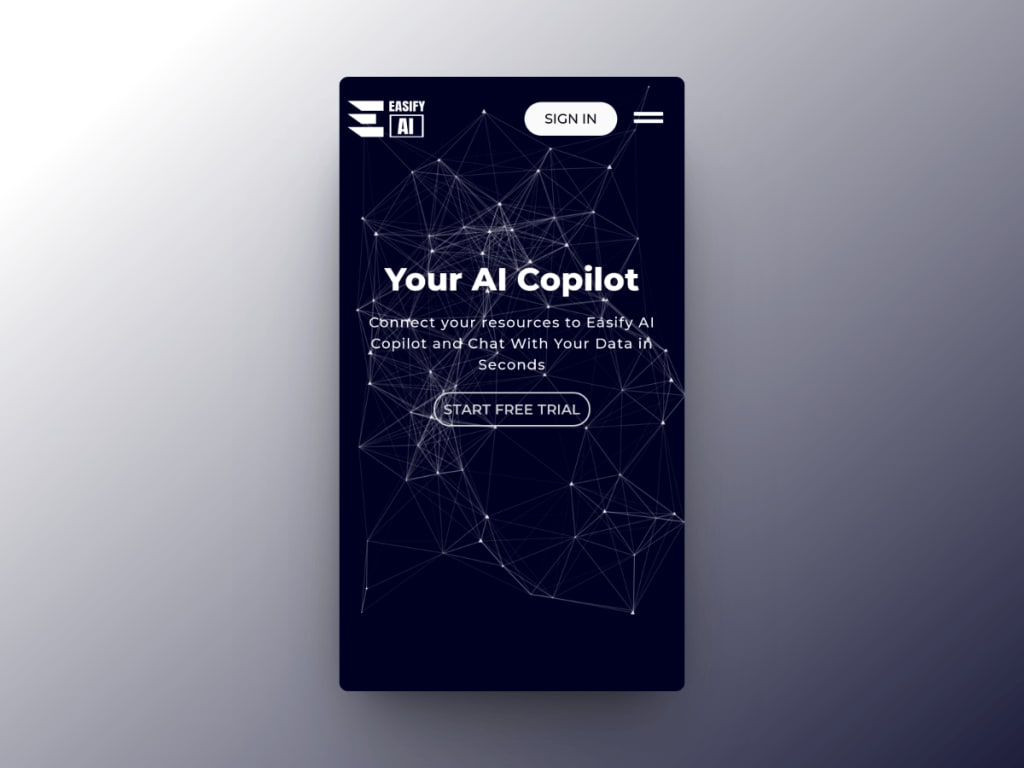
In the terms of this guide, AI is the product there, and the MVP was built to test exactly that.
Start with a scope
If you want a fixed price for your own AI MVP, our MVP Scoping Sprint produces the written scope in about two weeks for €900: the task, the evaluation approach, the data flow and hosting plan, and a fixed build price. The €900 is credited in full against the build if you build with us. If you already have a prototype built with an AI app builder, start with the €99 Prototype Check, also credited against the build.
When not to hire us
- You need research, not a product. Training new models or work at the edge of what models can do needs a machine learning research team.
- You have not tried the task by hand. Paste twenty real examples into a chat interface first. If the answers are not close to useful, an MVP will not change that.
- AI is a feature of an untested product. Then the product is the MVP. Read the SaaS MVP guide and add the model later.
For how we scope and run an MVP generally, see MVP development.
Work with us
Need to find out whether your AI idea works for real users?
We are a Budapest team that builds AI MVPs for founders across Europe, working remotely on CET. Send us what the AI should do, the data it needs, who will use it and how you will judge a good answer, and we reply within one business day.
Start a conversation ↗ MVP Development
Recent builds
[
Easify AI · SaaS & AI
AI MVP Development for a Database Querying SaaS
MVP
WordPress
React

On this page
- At a glance
- AI as the product, or AI as a feature
- How to build an AI MVP
- A typical stack
- Minimum feature set checklist
- LLM costs
- Worked example: cost per task
- Evaluation
- Metrics that show it is working
- Data privacy and the GDPR
- Typical scope and price
- Pitfalls specific to AI products
- Case study: Easify AI
- Start with a scope
- When not to hire us
Frequently asked
How much does it cost to build an AI MVP?
With Easify, an MVP built around one AI flow on a hosted model typically costs €8,000 to €15,000, and one that works over each customer's own documents or data, with tenant isolation and billing, €15,000 to €25,000. Model usage is billed separately by the provider. These are illustrative ranges, not a quote.
Do I need to train my own model for an AI MVP?
Almost never. Start with a hosted model through an API, a well-tested prompt and, if needed, retrieval over your own data. Training or fine-tuning is worth considering only once you have real usage data showing where the hosted model falls short.
How much will the LLM cost to run?
It depends on how many tokens each task uses, how many model calls a task makes and how many tasks users run. Work out the cost per task from the provider's published prices, multiply by expected usage, and put a cap per user before launch so a single heavy user cannot surprise you.
Is it GDPR compliant to send customer data to OpenAI or another model provider?
It can be, with the right set-up: a data processing agreement with the provider, a lawful basis for the processing, a valid mechanism for any transfer outside the EU, and sending only the data the task needs. Check the provider's retention and training settings, and get advice for anything sensitive.
How do I know if my AI feature is good enough to launch?
Build an evaluation set before the interface: real examples with the answers you expect. Run every prompt or model change against it, and launch when the results are good enough for the job and the failures are safe.
Should AI be the product or just a feature?
Ask what is left if you remove the model. If nothing is, AI is the product and the MVP should test whether its output is good enough to pay for. If a useful product remains, AI is a feature and the MVP should test the product first.
How long does it take to build an AI MVP?
With Easify, typically 6 to 8 weeks for one AI flow on a hosted model, and 8 to 12 weeks when it works over each customer's own documents or data. Collecting real examples and building the evaluation set is part of that time, and it is the part founders most often underestimate.
Why do so many AI projects stall after the proof of concept?
Gartner predicted in 2024 that at least 30% of generative AI projects would be abandoned after proof of concept by the end of 2025, citing poor data quality, inadequate risk controls, escalating costs or unclear business value. An MVP that measures output quality, cost per task and real usage from the start addresses all four.
Keep reading
[
Edtech MVP Development: Buyers, Children's Data and Scope
[
Enterprise Ireland Funding for Startups Building an MVP
](https://easifytechnologies.com/enterprise-ireland-funding-for-startups/)
[
EU Funding for Startups: Can It Pay for Your MVP?
](https://easifytechnologies.com/eu-funding-for-startups-mvp/)

Want this done properly on your own site?