this page
- title ............
- Booking Platform MVP: Features, Cost and What to Skip | Easify Technologies
- human_version ....
- easifytechnologies.com/booking-platform-mvp/
- raw_markdown .....
- /booking-platform-mvp.md
for agents
- /llms.txt ................
- a short index of the site for language models
- /{page}.md ...............
- any page as markdown, e.g. /pricing.md or /index.md
- Accept: text/markdown ....
- request any page with this header and you get its markdown
- /machine/{page}/ .........
- this view: the same markdown, readable in a browser
content
What a booking platform MVP needs: availability, scheduling, payments and deposits, notifications and two-sided onboarding, with a typical price range.
Source: https://easifytechnologies.com/booking-platform-mvp/
Booking Platform MVP: Features, Cost and Pitfalls
19 October 2026 Updated 20 October 2026 12 min read

A booking platform MVP needs four things to work: availability someone trusts, a booking that cannot be double-sold, a payment or deposit taken at the right moment, and messages that tell both sides what happens next. With Easify a booking MVP typically costs €4,000 to €10,000 when an operator confirms each booking by hand, and €12,000 to €25,000 when providers manage their own calendars and customers book and pay instantly, over 4 to 12 weeks. Everything else, from recurring bookings to two-way calendar sync, can usually wait.
Below: the three kinds of booking product, whether to build at all, how to model availability, the scheduling details that break booking systems, payments and deposits, notifications, onboarding both sides, a typical scope and price, and the pitfalls specific to booking products.
Work with us
Need a booking platform that takes real bookings and real payments?
Start a conversation ↗ MVP Development
At a glance
Question
Answer
Typical price with Easify
€4,000 to €10,000 with operator-confirmed bookings; €12,000 to €25,000 with self-managed availability and instant booking. Illustrative, not a quote
Timeline
4 to 12 weeks
Included
Availability, booking flow, payments or deposits, cancellation rules, email confirmations and reminders, provider onboarding, an admin view
Usually left out
Two-way calendar sync, recurring bookings, native apps, SMS, multi-location, dynamic pricing
Suits
Founders whose booking rules are the product: provider marketplaces, matched services, custom pricing
Not a fit
A single business booking its own staff, which an off-the-shelf scheduler handles
To get started, send
Who books whom, how availability works today, when you want to be paid, your cancellation policy, and your deadline
Which kind of booking product is it?
"Booking platform" covers three quite different products. The data model, the availability logic and the hard edge cases follow from which one you are building.
Kind
What is booked
Examples of the type
The hard part
Time slots
A person's time, in fixed durations
Appointments, lessons, consultations, home services
Working hours, buffers, travel time, time zones
Date ranges
A thing for a period
Rooms, equipment, vehicles, spaces
Overlapping ranges, minimum stays, check-in rules, deposits
Capacity
A place in a shared session
Classes, tours, events, workshops
Seat counts, waitlists, cancellations that free a seat
Some products mix them, such as a studio that rents rooms by the hour and runs classes. If yours does, pick the one that carries the business and add the other later.
Build, buy or adapt
Before scoping a custom build, check that you need one.
- Buy an off-the-shelf scheduler if you are one business booking your own staff or rooms. It will be cheaper for years.
- Use a hosted marketplace or booking platform if your model is standard and the open question is demand: providers list, customers book and pay, the platform takes a fee.
- Build custom when the booking logic is the product: matching customers to providers, vetting that the platform must control, pricing that depends on several factors, rules no scheduler supports, or a provider network you manage yourself.
A useful test: write down your three hardest booking rules. If an off-the-shelf tool handles all three, use it. If none of them fits, that is the case for building.
Choose the availability model first
Most of the scope follows from one decision: who controls availability, and how a booking becomes confirmed.
- Request and confirm. The customer asks for a time; a person (you or the provider) confirms. Cheapest to build, slowest for the customer, and ideal for testing demand. It also lets you match the customer to the right provider yourself.
- Operator-assigned. The customer books a service and a time; you assign a provider from your pool. Suits services where the customer cares about the outcome more than the individual.
- Provider-managed slots. Each provider sets working hours, breaks and time off; customers pick an open slot. This is where the real scheduling work starts.
- Instant booking. Provider-managed slots plus immediate confirmation and payment. The best experience and the most to get right, because there is no human in the loop to catch a mistake.
Starting with request-and-confirm and moving to instant booking once you know how providers actually work is a legitimate MVP path, and it often halves the first build.
Scheduling details that break booking systems
These are unglamorous, and each one is a support ticket if it is wrong.
- Time zones and daylight saving. Store every time in UTC with the provider's time zone alongside it, and display in the viewer's zone. A weekly slot at 09:00 must stay at 09:00 local time when the clocks change.
- Double bookings. Two customers can click the same slot in the same second. Check availability on the server inside a transaction, and back it with a database constraint. PostgreSQL can reject overlapping time ranges with an exclusion constraint, which makes the rule impossible to bypass.
- Buffers and travel time. If the provider travels to the customer, back-to-back slots across the city are not real availability.
- Lead time and cut-off. How late can someone book, and how late can they cancel? Both are rules, and both need to be enforced on the server.
- Calendar sync. One-way export (an iCal feed or invites the provider adds to their own calendar) is cheap. Two-way sync with Google or Microsoft calendars is a project of its own; leave it out until providers ask for it.
Payments and deposits
When you take money changes the build, the cancellation policy and the no-show rate.
- Pay in full at booking. Simplest. Refunds handle cancellations. Works well for short-notice, fixed-price services.
- Deposit now, balance later. Two payments to reconcile, but it protects the provider against no-shows without asking for everything up front.
- Card saved at booking, charged later. The customer authenticates once when booking, and you charge the card off-session when the service is delivered or a no-show fee applies. Stripe documents this as saving a card for later payments. In the EU, strong customer authentication rules make the initial set-up step necessary.
- An authorisation hold. Reserve the amount on the card and capture it later. Holds expire, typically after seven days for online card payments according to Stripe's documentation on holds, so this only suits bookings a few days away.
If independent providers are paid through the platform, you are also building a marketplace, with payouts and commission; the marketplace MVP guide covers that side. Write the cancellation policy before the payment flow, because the refund logic is the policy in code.
Notifications
Every change of state needs a message to the right person: booking requested, confirmed, changed, cancelled, reminder, and a follow-up afterwards.
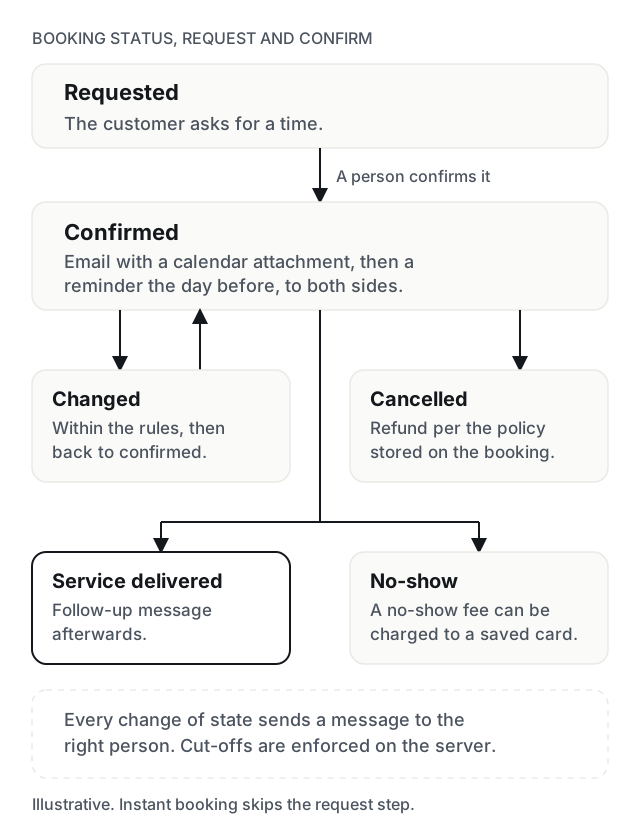
- Email first. Confirmation with a calendar attachment, a reminder the day before, and change or cancel links that work without logging in.
- SMS and WhatsApp later. Each message costs money and needs templates and opt-in. Add them when no-shows are measurably costing you.
- Tell the provider too. A provider who misses a new booking is the fastest way to lose a customer.
Reminders are worth doing well. A 2016 systematic review and meta-analysis in BMJ Open, covering healthcare appointments, found that patients who received digital notifications were 25% less likely to miss an appointment (15% against 21%), and that multiple notifications were more effective than single ones. Your service is not a clinic, but the direction is the same: a confirmation, a reminder the day before and, if no-shows prove costly, a second reminder closer to the time. Measure your own no-show rate before and after.
Onboarding both sides
A booking platform is usually two-sided, and the two sides need different onboarding.
- Providers need a profile, their services and prices, their availability, and whatever vetting the service demands. For childcare, care or home services that vetting is the product's reputation; do it by hand in the MVP, with a person reviewing documents, rather than automating a process you have not run yet.
- Customers should be able to book with as little as possible: name, contact details, the details the provider needs, and payment. Creating an account can come after the first booking.
Minimum feature set checklist
- Provider profiles with services, durations and prices
- Availability: working hours, time off and buffers, or a request-and-confirm flow
- A booking flow that shows real, current availability
- Server-side double-booking protection
- Time zones stored correctly, with daylight saving handled
- Payment, deposit or saved card at booking, matching the policy
- Cancellation and rescheduling rules enforced on the server
- Refunds, at least as an admin action
- Email confirmation with a calendar attachment
- Reminder before the booking, to both sides
- Provider vetting step, manual at first
- Admin view of bookings, providers and payments
- Terms, cancellation policy and privacy policy
The core data model
Most booking products come down to the same handful of records. Getting them right in the first version saves a painful migration later.
Record
What it holds
Watch out for
Provider
Profile, services offered, time zone, vetting status
One person working for several businesses
Service
Duration, price, buffer, who can deliver it
Prices that vary by provider or time
Availability
Working hours, exceptions, time off
Recurring rules across daylight-saving changes
Booking
Customer, provider, service, start and end, status
Overlaps, enforced in the database
Payment
Amount, type (full, deposit, saved card), status
Partial refunds and no-show fees
Policy
Cancellation window, fees, lead time
Policies that change after a booking was made
Notification
What was sent, to whom, when
Duplicate reminders after a reschedule
Store a copy of the cancellation policy on each booking at the moment it is made, so a later change to the policy does not rewrite the terms of existing bookings.
How a booking platform makes money
- Commission per booking. The most common for provider marketplaces. It needs payment through the platform, with payouts to providers.
- Provider subscription. Providers pay monthly for the tool. It can start with payment taken outside the platform, which makes version one smaller.
- Customer booking fee. A fixed fee on top of the price. Simple, but visible to the customer at checkout.
- Deposits and no-show fees. Not revenue in themselves, but they protect provider income and decide the payment flow.
Choose before scoping, because it decides whether payouts, commission and seller terms are in version one.
Build plan, step by step
- Take the first twenty bookings by hand, with a form, a calendar and payment links. Note every rule you apply.
- Write the rules down: lead time, cancellation window, deposit, buffers, who confirms.
- Choose the availability model and the payment model from the sections above.
- Scope version one around one service type, one city or niche, and the minimum feature set below. Our MVP Scoping Sprint does this in about two weeks for €900, credited in full against the build if you build with us.
- Onboard providers first, by hand, and let them check their availability looks right before customers arrive.
- Open booking to a small group of customers, watch every booking for the first weeks, and fix what confuses people.
- Measure no-shows, cancellations and repeat bookings, then decide what the second version needs.
Typical scope and price
Illustrative ranges inside our €4,000 to €25,000 MVP band, not a quote. The MVP cost calculator gives a range for your own scope, and our rates are on the pricing page.
Scope
What it includes
Price
Time
Request and confirm
Service pages, booking requests, operator confirmation, payment at booking, emails
€4,000 to €10,000
4 to 7 weeks
Self-service booking
Provider accounts and availability, instant booking, deposits or saved cards, reminders, admin
€12,000 to €20,000
8 to 10 weeks
Marketplace booking
The above plus provider payouts and commission, vetting workflow, reviews, one-way calendar export
€18,000 to €25,000
10 to 12 weeks
For comparison, EltexSoft puts a focused MVP at $25k to $80k (EltexSoft). That is one source's estimate, not a market average.
Pitfalls specific to booking platforms
- Building instant booking before you know how providers work. Real availability is messier than a weekly grid. Run request-and-confirm first if you are not sure.
- Preventing double bookings only in the interface. It works in testing and fails on a busy evening.
- Ignoring daylight saving. Every recurring slot shifts by an hour twice a year if times are stored naively.
- Taking payment at the wrong moment. Charging in full months ahead invites refunds; charging nothing invites no-shows.
- A cancellation policy that exists only in the terms. If the code does not enforce it, staff will enforce it by email, inconsistently.
- Two-way calendar sync in version one. It is expensive, and providers can live with an export for a while.
- Thin provider vetting. For services in someone's home or with children, one bad provider can cost the whole platform its reputation.
Case study: Nonstop Nanny
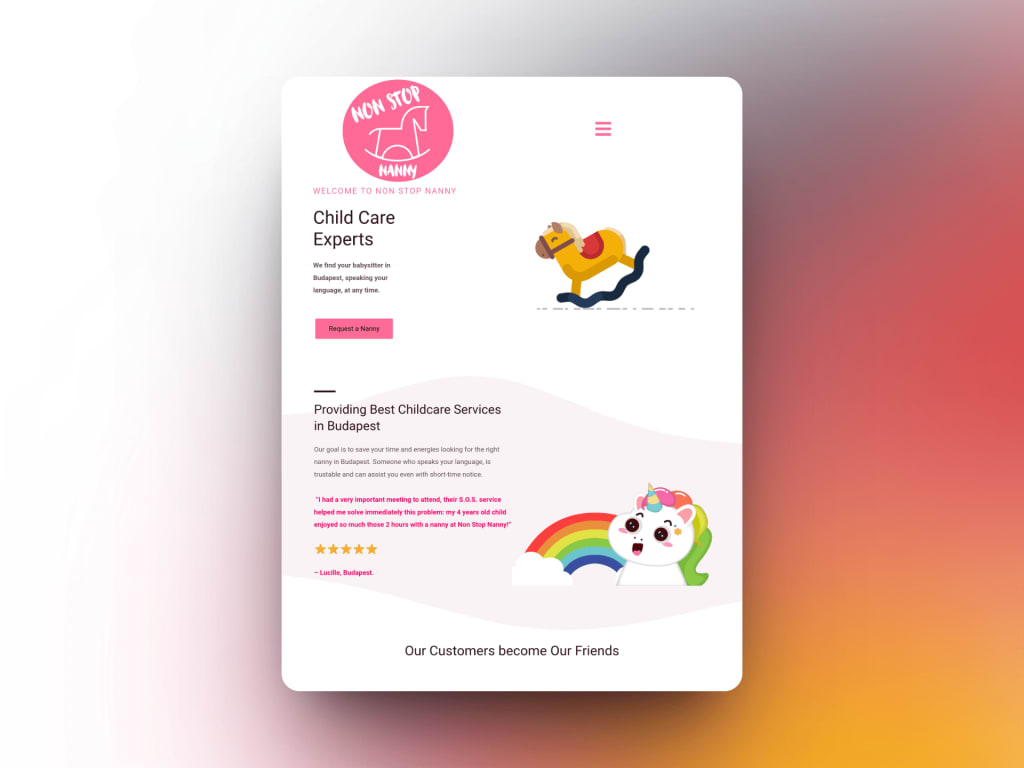
Nonstop Nanny is a childcare startup in Budapest that connects parents with babysitters. The team came to us with a concept, and we built the MVP it launched with, on WordPress and WooCommerce. Its case study records what the MVP had to do: connect parents with the most suitable babysitters from the Nonstop Nanny network, handle secure online payments, and be optimised for search so parents in Budapest could find it.
Parents fill in their details, specify their babysitting preferences and schedule sessions through a simple booking process, and pay for booked sessions online through the integrated payment system. The MVP was there so the concept could be tested with real users, and features were added and refined in iterations based on their feedback. It is also a reminder that a booking MVP does not need a custom framework: an established platform carried this one.
For the operator's side of the same problem, see Rostavo, a Laravel platform where in-home service agencies manage client bookings, staff scheduling, invoicing and payments from one dashboard. Its case study describes the starting point as spreadsheets, a shared calendar and a group chat, with double bookings and staff sent to the wrong address as the result.
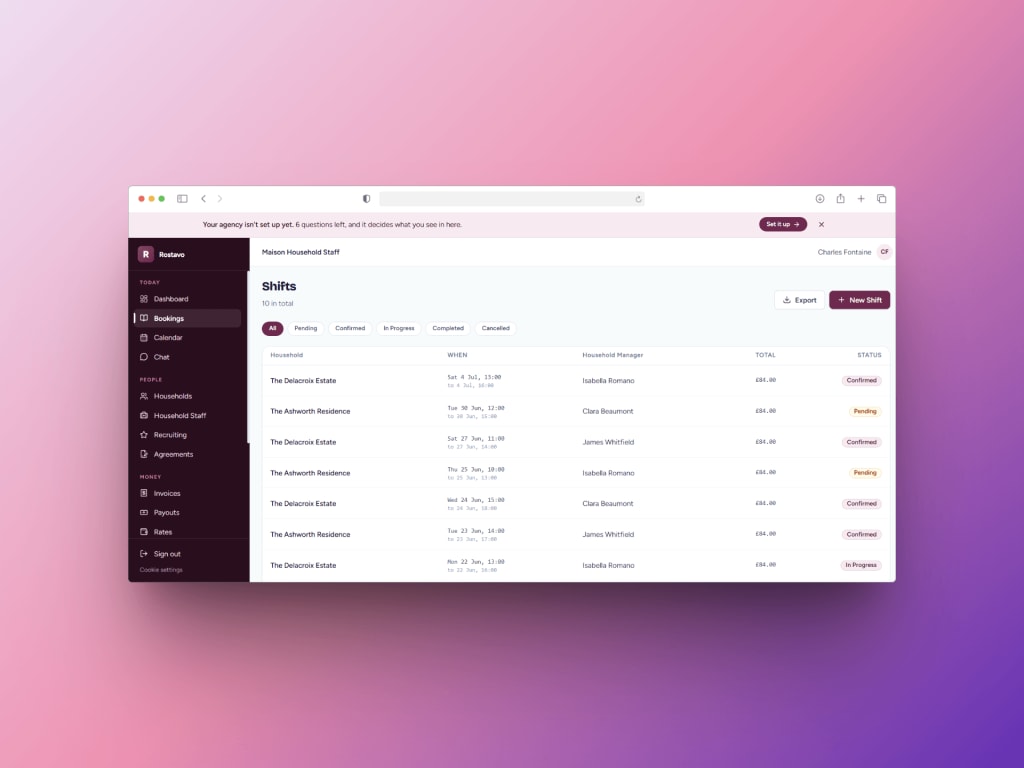
Every booking there carries an explicit status, and the list can be filtered by it. That is the state machine from the notifications section above, made visible to the people who run the service.
When not to hire us
- You are one business taking appointments. A hairdresser, a clinic or a consultant with their own staff should use an off-the-shelf scheduler. It will be cheaper for years.
- You have not taken a booking yet. Take the first twenty through a form and a payment link. You will learn the real rules (lead times, cancellations, the questions customers ask) and the build will be smaller.
- The rules change weekly. Software freezes rules. If you are still inventing the service, keep it manual until the rules settle.
For how we scope and run an MVP generally, and what you own at the end, see MVP development.
Work with us
Need a booking platform that takes real bookings and real payments?
We are a Budapest team that builds booking MVPs for founders across Europe, working remotely on CET. Send us who books whom, how availability works today, how and when you want to be paid, and your deadline, and we reply within one business day.
Start a conversation ↗ MVP Development
Recent builds
[
Nonstop Nanny · Childcare
Web MVP and SEO for a Babysitter Booking Platform
MVP
SEO
WordPress
WooCommerce
[
Rostavo · SaaS & AI
SaaS Platform Development for a Home Services Agency
SaaS platform
Laravel


On this page
- At a glance
- Which kind of booking product is it?
- Build, buy or adapt
- Choose the availability model first
- Scheduling details that break booking systems
- Payments and deposits
- Notifications
- Onboarding both sides
- Minimum feature set checklist
- The core data model
- How a booking platform makes money
- Build plan, step by step
- Typical scope and price
- Pitfalls specific to booking platforms
- Case study: Nonstop Nanny
- When not to hire us
Frequently asked
How much does it cost to build a booking platform MVP?
With Easify, a booking MVP typically costs €4,000 to €10,000 when an operator confirms each booking by hand, and €12,000 to €25,000 when providers manage their own availability and customers book and pay instantly. These ranges are illustrative, not a quote.
Should I build my own booking system or use Calendly or similar?
If you are one business taking appointments for your own staff, use an off-the-shelf scheduler. Build your own when the booking logic is the product: a marketplace of independent providers, matching, custom pricing, or rules no scheduler supports.
How do I take a deposit for a booking?
Either charge the deposit at booking and the balance later, or save the customer's card at booking and charge it off-session when the service is delivered or a no-show fee applies. Card authorisation holds expire, so a hold is only suitable for bookings a few days away.
How do I stop double bookings?
Enforce it in the database, not only in the interface. Two people can click the same slot in the same second, and only a constraint or a lock on the server will reject the second one reliably.
Do I need SMS reminders in the first version?
Usually not. Email confirmations, an email reminder the day before and a calendar invite cover most of it. Add SMS or WhatsApp when no-shows prove to be a real cost, because each message costs money.
Do reminders actually reduce no-shows?
The evidence from healthcare says yes. A 2016 meta-analysis in BMJ Open found patients who received digital notifications were 25% less likely to miss appointments, 15% against 21%, and that several notifications worked better than one. Start with email reminders and measure your own no-show rate.
How long does it take to build a booking platform MVP?
With Easify, about 4 to 7 weeks for request-and-confirm booking, 8 to 10 for self-service booking with provider calendars and deposits, and 10 to 12 when providers are paid out through the platform. These are illustrative; the written scope sets the real timeline.
How do booking platforms make money?
Usually a commission on each booking, a monthly subscription for providers, a booking fee paid by the customer, or a mix. A commission needs payment through the platform; a provider subscription can start with payment taken outside it, which makes the first build smaller.
Keep reading
[
Edtech MVP Development: Buyers, Children's Data and Scope
[
Enterprise Ireland Funding for Startups Building an MVP
](https://easifytechnologies.com/enterprise-ireland-funding-for-startups/)
[
EU Funding for Startups: Can It Pay for Your MVP?
](https://easifytechnologies.com/eu-funding-for-startups-mvp/)


Want this done properly on your own site?