this page
- title ............
- Proptech MVP Development: Features, Rules and Cost | Easify Technologies
- human_version ....
- easifytechnologies.com/proptech-mvp-development/
- raw_markdown .....
- /proptech-mvp-development.md
for agents
- /llms.txt ................
- a short index of the site for language models
- /{page}.md ...............
- any page as markdown, e.g. /pricing.md or /index.md
- Accept: text/markdown ....
- request any page with this header and you get its markdown
- /machine/{page}/ .........
- this view: the same markdown, readable in a browser
content
How to build a proptech MVP: listings, bookings, tenant flows, channel managers, rent payments, EU rental rules, a worked example and typical cost.
Source: https://easifytechnologies.com/proptech-mvp-development/
Proptech MVP Development: Listings, Bookings and Payments
20 October 2026 17 min read

A proptech MVP is usually one of three products: listings that generate enquiries, direct bookings for short stays, or a tenant and landlord platform for longer lets. Each needs listings people trust, availability that is right, and money taken at the right moment, and the expensive parts are the connections to channel managers and the payment flows. With Easify a proptech MVP typically costs €4,000 to €10,000 for listings with enquiries, €10,000 to €18,000 for direct booking, and €15,000 to €25,000 for a tenant and landlord platform with rent collection, over 4 to 12 weeks.
Below: choosing which of the three you are building, how to test demand first, listings, bookings and channel managers, what a listing must show, tenant and landlord flows, payments and deposits, what to build and what to buy, the rules that apply, a minimum feature set, what to leave out, a week-by-week plan, a worked example, what to measure, typical scope and price, running costs, common mistakes, the rental work we have done, and when not to hire us. The regulatory points are orientation, not legal advice.
Work with us
Building a property or rental platform that needs real listings, bookings and payments?
Start a conversation ↗ MVP Development
At a glance
Question
Answer
Typical price with Easify
€4,000 to €10,000 listings and enquiries; €10,000 to €18,000 direct booking; €15,000 to €25,000 tenant and landlord platform. Illustrative, not a quote
Timeline
4 to 12 weeks
Decide first
Listings, short-stay booking, or long-let management
OTA connections
Through a channel manager's API; direct OTA access is rarely available to a new platform
Payments
A licensed provider such as Stripe Connect when money passes to landlords or hosts
Rules to know about
EU short-term rental data rules (from 20 May 2026), PSD2 for money movement, GDPR for tenant data
Built before
A Next.js serviced accommodation platform, a property management site with listings and booking-software integration, channel management for a hospitality business
First step
The €900 MVP Scoping Sprint, credited in full against the build if you build with us
Decide which proptech product you are building
- Listings and enquiries. Properties, search and filters, and an enquiry or viewing request. Cheapest, and it answers whether anyone wants what you list.
- Short-stay direct booking. Availability, instant or requested booking, payment, and sync with the channels where the same unit is also sold. Most of the booking logic is in the booking platform guide; this page covers what is specific to property.
- Long-let tenant and landlord platform. Applications, tenancy records, rent collection, maintenance requests and documents. Fewer transactions, more money per transaction, and more personal data.
- A marketplace of independent landlords or hosts. Any of the above with onboarding, payouts and commission for many providers.
If you are
You are probably building
The riskiest assumption
An operator with your own units
Direct booking, connected to the channels you already use
That guests will book direct instead of through an OTA
A letting agent or property manager
Listings and enquiries, then a tenant and landlord portal
That landlords will move their work into your tool
A founder with no supply yet
A marketplace, starting as listings you collect by hand
That you can get enough supply in one city to be useful
A service for tenants
Applications, documents and payments for one side
That landlords will accept what tenants bring from your product
For a marketplace, read the marketplace MVP guide too: the chicken-and-egg problem of supply and demand matters more than any property feature.
Test demand before you build
Property is a market where the first test can usually be done without much software.
- Collect supply by hand. Ten to twenty properties, listed with real photos and facts on a simple site or even a shared document. If you cannot get the first ten, software will not get you the next hundred.
- Send real traffic to it. One channel, such as a local community, a relocation agent or a small ad budget, pointed at one city.
- Handle enquiries and bookings manually. Reply by email, take payment by invoice or a payment link, and write down every question people ask.
- Build what the manual version showed. The questions people asked become the listing fields; the steps you did by hand become the flows.
Listings, bookings and channel managers
- Listings people trust. Real photos, the facts people decide on (price, availability, location, what is included), and a visible sign that the provider has been checked if you vet them.
- Search that is fast. People compare accommodation in several tabs at once. Filter by date, location and price on the server, and keep the page light.
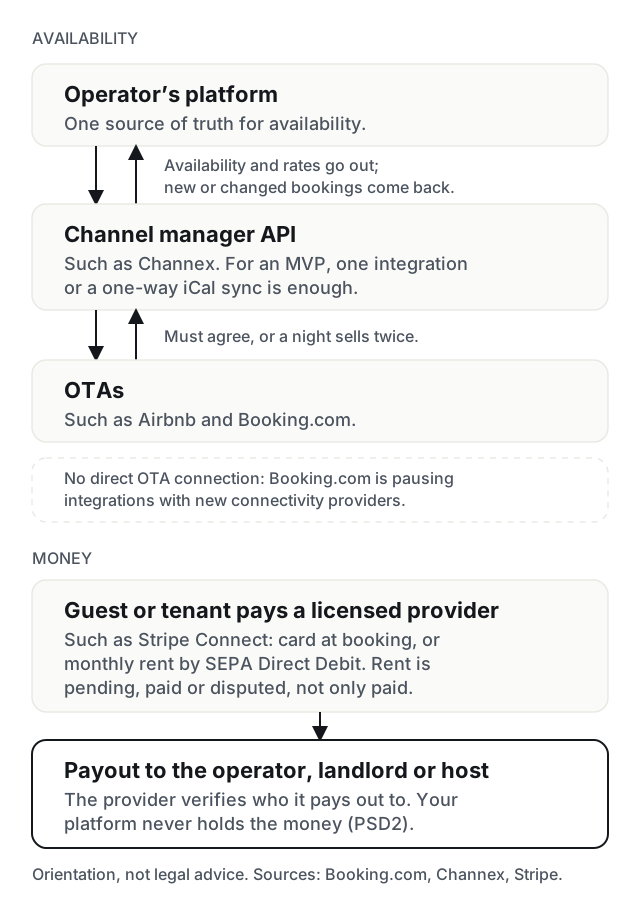
- Availability with one source of truth. If a unit is also sold on Airbnb or Booking.com, your platform and the channels must agree, or you sell the same night twice.
- Channel managers rather than direct OTA connections. Booking.com's connectivity page says it is pausing integrations with new connectivity providers until further notice and does not accept direct connections from individual properties. Channel manager APIs such as Channex offer availability, rates and inventory endpoints, and staging test accounts for Booking.com and Airbnb, aimed at teams building property management software. For an MVP, one channel manager integration, or a one-way iCal sync, is enough.
- Integrate with what the operator already uses. Many operators have booking or property management software. Pulling availability from it is often cheaper than replacing it.
Questions to put to a channel manager before you commit to it:
- Which channels can we connect through you, and is there a staging account for each?
- What does your API cover: availability, rates, restrictions, bookings, modifications, cancellations?
- How do you notify us of a new or changed booking, and what happens if our system is down when you do?
- What does it cost per property or per booking, and is there a minimum?
- What do you need from us before you switch on production?
What a listing must show
The facts on a listing are partly a design question and partly a legal one.
- The facts people decide on. Price including mandatory fees, availability, location precise enough to judge the commute, size, what is included, and the rules (pets, smoking, minimum stay).
- Energy performance. Under Article 12(4) of the Energy Performance of Buildings Directive, Member States must require that when a building or unit with an energy performance certificate is offered for sale or rent, its energy performance indicator is stated in advertisements in commercial media. National rules implement this differently, so the MVP needs an energy rating field and a place to show it.
- A registration number for short-term rentals in a registration area, as set out in the rules section below.
- Who the provider is. On a marketplace, whether the listing is from a private host, a professional or the platform itself, and whether you have checked them.
Tenant and landlord flows
For longer lets, the product is a set of workflows between two parties who do not fully trust each other.
- Landlord side: add a property, set rent and terms, review applications, sign a tenancy, see payments, handle maintenance.
- Tenant side: find a property, apply with documents, sign, pay, report a problem, get the deposit back.
- Documents. Tenancy agreements, inventories and certificates, stored with a clear record of who uploaded and who has seen what.
- Maintenance. A request with photos, a status, and a message thread. Contractor dispatch can be a phone call in version one.
- Screening. Identity and affordability checks can be done by hand or by a specialist provider at first. Data on criminal convictions can only be processed under official authority or where Union or Member State law authorises it (GDPR Article 10), so keep it out of the MVP unless your lawyer confirms the basis.
Payments and deposits
- Short-stay bookings are usually paid by card at booking, with a deposit or a saved card for damage; the booking platform guide covers deposits and holds.
- Monthly rent suits SEPA Direct Debit. The tenant accepts a mandate once, and you collect each month. Stripe's SEPA Direct Debit documentation advises waiting at least six business days before treating a payment as successful, and notes that customers can dispute a payment through their bank on a no-questions-asked basis for up to eight weeks. Build rent status around "pending" and "disputed", not only "paid".
- Paying landlords or hosts through your platform means you are collecting money for someone else, which is usually a payment service under PSD2. Article 37 prohibits anyone who is neither a payment service provider nor explicitly excluded from providing payment services. Use a licensed provider such as Stripe Connect, which handles the money movement and verifies the landlords it pays out to. The fintech MVP guide covers when a partner's licence covers you and when it does not.
- Security deposits are often subject to national rules on where and how they are held. Check the rules in your launch country before you design the flow, and do not hold deposits in your own account.
What to build and what to buy
Most of a proptech MVP's cost is in connecting to services that already exist. A decision table for version one:
Need
Build it yourself?
Usual MVP choice
Listings, search, filters
Yes, this is your product
Built, with search filtered on the server
Maps
No
A maps provider's embed or API, with a static map where interaction is not needed
Availability across channels
No
One channel manager API, or a one-way iCal sync
Card and SEPA payments, payouts
No
A licensed provider such as Stripe Connect
Identity and affordability checks
No
By hand, or a specialist screening provider
Tenancy agreements and signatures
Partly
Your template, signed through an e-signature provider
Messaging
Yes, simply
In-app messages with email notifications
Valuations
No
Leave out, or show comparable listings you already hold
Virtual tours
No
Embed video or a tour from an existing provider
Property management for operators
No
Integrate with the software the operator already uses
On signatures: Article 25 of the eIDAS Regulation says an electronic signature shall not be denied legal effect and admissibility as evidence solely because it is electronic or is not a qualified signature, and that a qualified electronic signature has the equivalent legal effect of a handwritten one. Some countries require particular forms for some tenancy documents, so check before you design the signing flow.
The rules that apply
Orientation only; national rules on letting vary widely, so check your launch country.
- EU short-term rental rules. Regulation (EU) 2024/1028 on data collection and sharing for short-term accommodation rentals has applied since 20 May 2026 (Article 19). Article 7 requires platforms, where a registration procedure applies, to ask hosts whether the unit is in such an area, ensure a registration number is provided before the listing goes live, show it in the listing, and make reasonable efforts to check declarations and numbers at random. Platforms must also share activity data with authorities; small or micro platforms below a monthly average of 4,250 listings may do so manually (Article 9(2)). A platform that only lists its own operator's units is a different case from a platform for independent hosts, so ask your lawyer which applies.
- Payments. As above: use a licensed provider when money passes to someone else.
- Personal data. Tenant applications carry identity documents, income evidence and contact details. Collect what the decision needs, set a retention period for rejected applicants, and limit who on the landlord side can see what. We deploy client products to EU data-centre regions, so the product is hosted in the EU; our engineers work from India, so production access is kept to what the work needs.
Minimum feature set checklist
- Property listings with photos, key facts, location and price
- Search and filters on dates, location and price
- Availability with one source of truth
- Enquiry, viewing request or booking flow
- Payment at booking, or rent collection by SEPA Direct Debit, through a licensed provider
- Landlord or host onboarding, verified by the payments provider if they are paid out
- Registration number field and display, if you list short-term rentals in a registration area
- Messages between both sides, with email notifications
- Admin view of listings, bookings or tenancies, and payments
- One channel manager integration or iCal sync, if units are also sold elsewhere
- Terms, cancellation policy and privacy policy
What to leave out of version one
- Direct OTA integrations. Use a channel manager's API.
- Automated tenant screening. Do it by hand or through a provider.
- Dynamic pricing. Set prices by hand until you have occupancy data.
- Smart locks and IoT. Send access codes by message at first.
- Accounting exports and landlord statements. A CSV export and a monthly email will do.
- Native apps. A fast, mobile-first web app is enough for most proptech pilots.
- Valuation models and virtual tours. Both are products of their own; embed or link an existing one if users need it.
Week by week: a direct booking build
An illustrative plan for the middle scope on this page, about 8 weeks after the Scoping Sprint. A listings site compresses this into 4 to 6 weeks; a tenant and landlord platform stretches it to 9 to 12.
Weeks
What happens
What you do
Before week 1
Scoping Sprint: which product, where availability lives, who moves the money, fixed price
Open accounts with the channel manager and payments provider
1
Design of search, listing and booking screens
Gather real photos and facts for the first properties
2 to 3
Listings, search, property pages, admin
Load properties; review weekly builds
4 to 5
Availability, booking flow, payment and deposit through the provider
Agree cancellation and deposit rules
6
Channel manager or iCal sync, tested on staging
Check that test bookings appear on both sides
7
Emails, messages, terms and privacy policy, registration number display if needed
Write the policies with your lawyer
8
Fixes, real test bookings, launch
Take the first bookings yourself and watch every step
A worked example
A fictional product, to show how the scope and price fit together. It is not a client.
The idea. An operator with 25 furnished flats in one city rents them by the month to relocating professionals. Today it sells through two portals and a spreadsheet, and loses track of who has paid.
The question the MVP answers. Will companies and tenants book monthly stays directly, and can the operator stop using the spreadsheet?
In version one:
- Listings for the 25 flats with photos, facts, energy rating and monthly price
- Search by move-in date, length of stay and budget
- A booking request the operator approves, then payment of the first month and deposit by card through Stripe
- Monthly rent by SEPA Direct Debit after that, with pending, paid and disputed states
- Availability synced one way to the portals by iCal
- Tenant documents uploaded once, visible only to the operator
- An admin view of flats, stays, payments and documents, with a CSV export for the accountant
Left out: a channel manager integration (iCal is enough for two portals), screening by a provider (done by hand), maintenance requests (handled by phone and email), smart locks, dynamic pricing, a tenant app.
Where it falls. Between the direct booking and tenant and landlord rows in the price table below: roughly €14,000 to €20,000 and 8 to 10 weeks with Easify. Illustrative, not a quote.
What to measure
- Supply: listings live, and the share kept up to date.
- Conversion: enquiries or booking requests per listing view, and how many become paid bookings or signed tenancies.
- Direct share: for operators, the share of bookings that came direct rather than through an OTA, which is usually what the MVP is meant to prove.
- Time saved: for property managers, the hours a week the tool replaces.
- Payment health: failed and disputed payments, and how long a payout takes to reach the landlord.
Typical scope and price
Illustrative ranges inside our €4,000 to €25,000 MVP band, not a quote. Rates are on the pricing page.
Scope
What it includes
Price
Time
Listings and enquiries
Listings with search and filters, property pages, enquiry and viewing requests, admin to manage listings
€4,000 to €10,000
4 to 6 weeks
Direct booking
The above plus availability, booking and payment, deposits, one channel manager or iCal sync, emails
€10,000 to €18,000
6 to 10 weeks
Tenant and landlord platform
Applications with documents, tenancies, SEPA rent collection through a licensed provider, landlord payouts, maintenance requests, messages
€15,000 to €25,000
9 to 12 weeks
What moves a scope up or down the range:
Cost driver
Why it costs more
Two-sided marketplace
Onboarding, payouts, commission and trust features for many providers
Channel manager API instead of iCal
Two-way sync, modifications, cancellations and error handling
Long-let payments
Mandates, retries, disputes and payouts, each with its own states
Several countries
Different deposit, registration and tenancy rules, and translations
Map-heavy search
Map interaction, clustering and location filters cost more than a list with a map
Documents with signatures
Templates, signing flow and storage with access control
Running costs after launch
- Hosting in an EU region, plus image storage and delivery, which grows with photos.
- Payments: per-transaction fees from the payments provider, on bookings and on rent.
- Channel manager: usually a monthly fee per property.
- Maps: usage-based once traffic grows, so load interactive maps only where they are needed.
- E-signatures and screening: per document or per check.
- Support and changes after launch, which is what our retainer on the pricing page covers.
For how founders pay for the build itself, including grants that can cover an MVP, see MVP grants and funding in Europe.
Common mistakes
- Building before you have supply. A beautiful search page with five listings tests nothing.
- Two sources of availability. If the operator updates a spreadsheet and your platform separately, double bookings follow.
- Treating "paid" as one state. Card payments can be refunded and charged back, and SEPA debits can be disputed for weeks.
- Holding guests' or tenants' money yourself. It is usually a regulated activity; use a licensed provider.
- Ignoring national rules until launch. Deposits, registration numbers, energy ratings and tenancy forms differ by country and change the flows.
- Replacing the operator's existing software. Integrating with it is usually cheaper and easier to sell.
Rental and hospitality work we have done
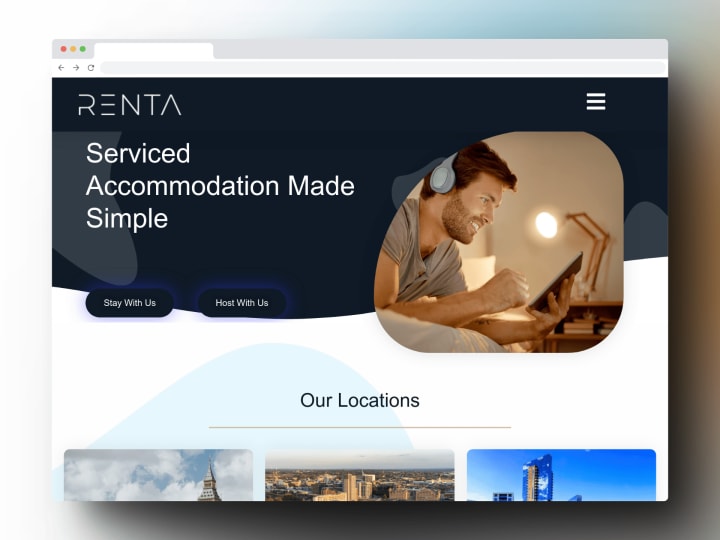
- Renta Stay is a property listing platform for the UK's serviced accommodation market. We built it on Next.js and React rather than a template so that search and listing pages could be genuinely quick, presented verified providers as such, and designed it mobile first. Visitors can explore properties, check availability and submit enquiries.
- Renta Properties is a UK property management company. We redesigned its WordPress site, added property listings that visitors can filter, an admin panel for its team to add and edit listings, and an integration with its existing booking management software that synchronises property availability automatically.
- Bottega Polanco is a hospitality business in Mexico City. We implemented channel management software so it could update rates, availability and property details across OTAs such as Airbnb and Booking.com from one place, and built a website with a booking system for direct reservations.
Start with the Scoping Sprint
The €900 MVP Scoping Sprint is the step we recommend before a proptech build. In about two weeks you get, in writing: the one question the MVP must answer, the smallest feature set that answers it, what is deliberately left out, the main user flows, the technical and hosting plan, and a fixed price and timeline for the build. For property, it settles which of the three products you are building, where availability lives, and which provider moves the money. The €900 is credited in full against the build if you build with us, and the scope is yours to keep whatever you decide.
When not to hire us
- You manage your own portfolio and need a booking engine. Off-the-shelf property management software with a booking engine will be cheaper for years.
- You want an MVP that connects directly to every OTA. That is not available to a new platform, and we will not promise it.
- You plan to hold tenants' money yourself. Talk to a lawyer first; the payment flow depends on the answer.
- You have not listed a single property. List the first ten by hand on a simple site and see who enquires.
Work with us
Building a property or rental platform that needs real listings, bookings and payments?
We are a Budapest team that builds MVPs for founders across Europe, working remotely on CET, and we have built property listing, booking and channel management work for rental businesses. Send us who lists, who books or rents, how money moves today and your deadline, or ask for the €900 MVP Scoping Sprint, which is credited in full against the build if you build with us, and we reply within one business day.
Start a conversation ↗ MVP Development
Recent builds
[
Renta Stay · Property
Next.js Booking Platform for UK Serviced Accommodation
Web app
Next.js
React
[
Renta Properties · Property
Website Redesign for a UK Property Management Company
Web design
Web development
WordPress
](https://easifytechnologies.com/case-study/renta-properties/)
[
Bottega Polanco · Hospitality
SEO and Channel Management for a Hospitality Business
- SEO
- Channel management
- Marketing
](https://easifytechnologies.com/case-study/bottega-polanco/)


On this page
- At a glance
- Decide which proptech product you are building
- Test demand before you build
- Listings, bookings and channel managers
- What a listing must show
- Tenant and landlord flows
- Payments and deposits
- What to build and what to buy
- The rules that apply
- Minimum feature set checklist
- What to leave out of version one
- Week by week: a direct booking build
- A worked example
- What to measure
- Typical scope and price
- Running costs after launch
- Common mistakes
- Rental and hospitality work we have done
- Start with the Scoping Sprint
- When not to hire us
Frequently asked
How much does a proptech MVP cost?
With Easify, a listings site with enquiries typically costs €4,000 to €10,000, a direct booking platform with payments €10,000 to €18,000, and a tenant and landlord platform with rent collection €15,000 to €25,000, over 4 to 12 weeks. These ranges are illustrative, not a quote.
Can I connect my platform directly to Airbnb and Booking.com?
Usually not as a new startup. Booking.com's connectivity page says it is pausing integrations with new connectivity providers until further notice and does not accept direct connections from individual properties. The practical route is to integrate with a channel manager that is already connected, through its API.
Can my platform collect rent and pay it to landlords?
Collecting money from tenants and paying it to landlords is usually a regulated payment service in the EU, so most platforms use a licensed payments provider such as Stripe Connect to do it. SEPA Direct Debit suits monthly rent, but a payment is only safely successful after about six business days, and tenants can dispute a debit without giving a reason for eight weeks. This is orientation, not legal advice.
What do the EU short-term rental rules mean for my platform?
Regulation (EU) 2024/1028 has applied since 20 May 2026. Where a registration scheme applies, a short-term rental platform must ask hosts whether their unit is in a registration area, require a registration number before the listing goes live, display it, and make random checks. Small and micro platforms below 4,250 listings a month may share activity data manually.
Should a proptech MVP include tenant screening?
Do it by hand, or through a specialist provider, in version one. Screening involves identity, income and sometimes credit or criminal records data, and criminal records in particular can only be processed under official authority or where law authorises it, under GDPR Article 10.
How long does it take to build a proptech MVP?
With Easify, typically 4 to 6 weeks for listings with enquiries, 6 to 10 weeks for direct booking with payments and a channel manager, and 9 to 12 weeks for a tenant and landlord platform with rent collection. Getting production access from a channel manager or payments provider can add time, so start those conversations during scoping.
What features should a real estate MVP have?
Listings with the facts people decide on, search and filters, availability with one source of truth, and the one action you are testing: an enquiry, a booking or a rental application. Add payments through a licensed provider only if money changes hands in the test. Valuation tools, virtual tours, dynamic pricing and smart locks can wait.
Can tenants sign tenancy agreements electronically?
In the EU, the eIDAS Regulation says an electronic signature may not be denied legal effect solely because it is electronic, and a qualified electronic signature has the same effect as a handwritten one. Some countries still require particular forms for some tenancy documents, so check the launch country and use an e-signature provider rather than building signing yourself.
Keep reading
[
Edtech MVP Development: Buyers, Children's Data and Scope
[
Enterprise Ireland Funding for Startups Building an MVP
](https://easifytechnologies.com/enterprise-ireland-funding-for-startups/)
[
EU Funding for Startups: Can It Pay for Your MVP?
](https://easifytechnologies.com/eu-funding-for-startups-mvp/)


Want this done properly on your own site?