this page
- title ............
- How Long Does It Take to Build an MVP? A Phase Guide | Easify Technologies
- human_version ....
- easifytechnologies.com/how-long-does-it-take-to-build-an-mvp/
- raw_markdown .....
- /how-long-does-it-take-to-build-an-mvp.md
for agents
- /llms.txt ................
- a short index of the site for language models
- /{page}.md ...............
- any page as markdown, e.g. /pricing.md or /index.md
- Accept: text/markdown ....
- request any page with this header and you get its markdown
- /machine/{page}/ .........
- this view: the same markdown, readable in a browser
content
An MVP takes 4 to 12 weeks with Easify. How the weeks break down by phase and size, what slows projects down, app store lead times and how to go faster.
Source: https://easifytechnologies.com/how-long-does-it-take-to-build-an-mvp/
How Long Does It Take to Build an MVP?
19 October 2026 Updated 20 October 2026 11 min read

An MVP takes four to twelve weeks with Easify, from the first scoping conversation to a live product with real users. A single-flow web app with accounts and payments sits near four to six weeks; a booking platform or marketplace with two sides and several integrations sits nearer ten to twelve. The scope decides the length far more than the team does.
Below: how other published estimates compare, the phases week by week, timelines by size, the lead times outside anyone's control (app stores, payment providers, developer accounts), what slows projects down, and the honest ways to go faster.
Work with us
Need to know how many weeks your MVP really needs?
Start a conversation ↗ MVP Development
At a glance
Typical Easify timeline
4 to 12 weeks
Scoping
About 2 weeks: the MVP Scoping Sprint, €900, credited in full against the build if you build with us
Design and build
2 to 8 weeks, in stages you can use
Testing and launch
About 1 week for the web; add store lead times for mobile
Biggest cause of delay
Changing scope and slow decisions
Fastest honest lever
Cutting features that do not change the answer
Price for that time
Typically €4,000 to €25,000 at €25 to €45 an hour
How other estimates compare
Published timelines vary because firms define "MVP" differently and count from different starting points. A few you will find when you search:
Source
Estimate
About three to four months for a typical MVP
4 to 8 weeks for a lean build, 2 to 4 months for a standard one, 4 to 8 months for a complex one
Three to four months, from its own projects and its network
Easify
4 to 12 weeks, scoping included
Our range sits at the shorter end because it assumes a tightly cut, web-first scope, and each estimate above is one firm's view of its own work. When you compare, ask what each timeline includes: scoping, design, testing, a store release, and whether the clock starts at signature or at the first line of code.
The phases, week by week
This is the usual shape of an Easify MVP. The weeks are a guide, not a promise; the written scope at the end of phase one is where a real timeline comes from.
Phase 1: scope (weeks 1 to 2)
We agree the one question the MVP has to answer, the smallest product that answers it, and what is deliberately left out. This is the MVP Scoping Sprint: €900 fixed, about two weeks, a written scope with user flows, the hosting plan and a fixed price and timeline for the build. It is yours whatever you decide next, and the €900 is credited in full against the build if you build with us.
This phase feels slow to founders who want to see screens. It is the phase that saves the most time, because every feature cut here is a week not spent later.
What you need to bring: who the users are, what you want them to do, what would count as a yes, and any deadline that is real (an investor meeting, a trade fair, a pilot with a named customer).
Phase 2: design (overlaps weeks 2 to 4)
The key screens of the core flow, built on a proven component library rather than a bespoke visual system. For an MVP, clarity matters more than polish. Design usually overlaps the start of the build rather than finishing before it.
Phase 3: build in stages (weeks 3 to 10)
The core flow first, then payments, then the supporting screens. Each stage ends with something you can use, not a progress report. That matters for two reasons: you react to software rather than to a plan, and a new idea is visibly a change to something real, so scope creep is caught when it happens rather than at the end.
We build on the same foundations as any other project: version-controlled database migrations, authorisation checked on the server, and a real deployment pipeline. It costs a little more time in the first weeks and it means the MVP can be kept if it works.
Phase 4: test and launch (about 1 week)
Testing the paths that cost you money if they break: signing up, paying, and the two or three actions the product exists for. Then a production deployment, error tracking, and the measurement of the specific behaviour you are betting on.
A web launch can happen the same day. A mobile release adds store review and, on Google Play, possibly a testing period first (see lead times below).
Phase 5: measure and decide
Not part of the build, but part of the point. Once real users arrive, you find out whether the thing you were testing actually happens. Then you decide whether to build on it, change direction or stop. All three are legitimate outcomes.
Timelines by size
These are illustrative, to show how scope maps to weeks. Each row includes about two weeks of scoping.
Size
What is in it
Scope
Design and build
Test and launch
Total
Small
One user type, one core flow, accounts, one payment plan, a plain interface
2 weeks
2 to 3 weeks
1 week
4 to 6 weeks
Medium
Two user types, or one significant integration such as a calendar, a map or an AI model
2 weeks
3 to 6 weeks
1 week
6 to 9 weeks
Large
A two-sided marketplace with verification, several integrations, or a compliance requirement such as health or children's data
2 weeks
6 to 9 weeks
1 week
9 to 12 weeks
If your idea looks bigger than twelve weeks, it is usually more than one MVP. Ask which part answers the question first.
For type-specific timelines, see the guides to SaaS, booking platform, marketplace and AI MVPs.
Lead times outside anyone's control
Some steps run on someone else's clock. They do not take much effort, but they take calendar time, so start them in week one.
Step
What to know
Plan for
Apple App Store review
Apple says it typically reviews at least 50% of submissions in under 24 hours and 90% in under 48 hours. Incomplete submissions take longer, and a rejection means another round
A few days, more if rejected
Apple developer account for a company
Apple requires a D-U-N-S Number to verify an organisation's identity and legal status before enrolment
Check you have one before the build starts
Google Play, new personal account
A personal developer account created after 13 November 2023 must run a closed test with at least 12 testers, opted in for at least 14 days continuously, before it can apply for production access
At least two weeks before launch
Payment provider
Payouts and live payments need the business verified by the provider
Start it with the first build stage
Partner APIs and data
Access to a partner's system, a bank or a data provider often goes through their own approval
Ask in week one; it can be the longest wait of all
Domain, email and legal text
Terms, privacy policy, cookie consent
A few days of your time, but easy to leave too late
The Google Play rule alone is a good reason to test an idea as a web app first when the question allows it.
What slows MVP projects down
None of these is unusual, and most can be avoided:
- Scope that keeps moving. Each new feature mid-build costs its own time plus the time to fit it around what already exists. Keep a "later" list and add to that instead.
- Slow decisions. A question that waits three days for an answer stalls whatever depends on it. Name one person on your side who can decide, and agree how quickly they reply.
- Missing content and access. Copy, images, legal text, the domain, the Stripe account, the Apple developer account. These are on the founder's side and they are the classic cause of a finished build waiting to launch.
- Third-party approvals. Payment provider verification, app store review, API access from a partner. Start them in week one, not in the last week.
- Building the admin first. Dashboards, settings and reporting feel essential and rarely change the answer. They can almost always wait.
- Native apps by default. Two mobile apps take longer than one responsive web app, and add store review. If the idea can be tested on the web, test it there.
- Polishing before anyone has used it. Visual refinement is cheap to add later and expensive to redo once real users show you what matters.
Founder's week-one checklist
Everything here is on your side, and each item can hold up a launch if it is left to the end:
- One named decision-maker, with an agreed reply time
- A list of five to twenty people who will try the first version
- The payment provider account opened in the company's name
- App store developer accounts, if a mobile release is planned (and a D-U-N-S Number for Apple)
- The domain and a business email address
- Terms of service, privacy policy and cookie consent text, or a plan to get them
- Logo, product name and any copy the core screens need
- Access requests sent to any partner whose API or data the product needs
- The one metric that will tell you whether the MVP worked
How to go faster, honestly
There are real ways to shorten an MVP, and some that only look like it.
Ways that work:
- Cut the scope. The only lever that reliably works. Ask of every feature: would the answer to our question change without it? If not, it waits.
- Decide quickly. A founder who reviews each stage within a day can take weeks off a project.
- Prepare your side in week one. The checklist above.
- Use standard pieces. Off-the-shelf authentication, payments and components instead of custom versions.
- Do part of it by hand. Approving providers, matching customers or sending some emails manually, until volume justifies automating it.
- Launch to a small group first. Ten real users on a narrow version tell you more than a hundred on a version that took twice as long.
Ways that look faster and are not:
- Skipping the scope phase. It feels like two weeks saved and usually costs more than two weeks in rework.
- Skipping the foundations. No migrations, authorisation in the browser, no tests. It is quicker for a few weeks, and then the MVP works, finds users, and has to be rebuilt before it can grow.
- Adding people late. New developers need time to learn the codebase, and a small product has only so much work that can happen in parallel.
- A rushed AI-generated build presented as finished. Tools like Lovable, Bolt and v0 are fast at producing a convincing demo, which is a good way to test an idea. Treating that demo as production software is where the known risks are: authorisation checked only in the browser, open database rules, keys in client-side code.
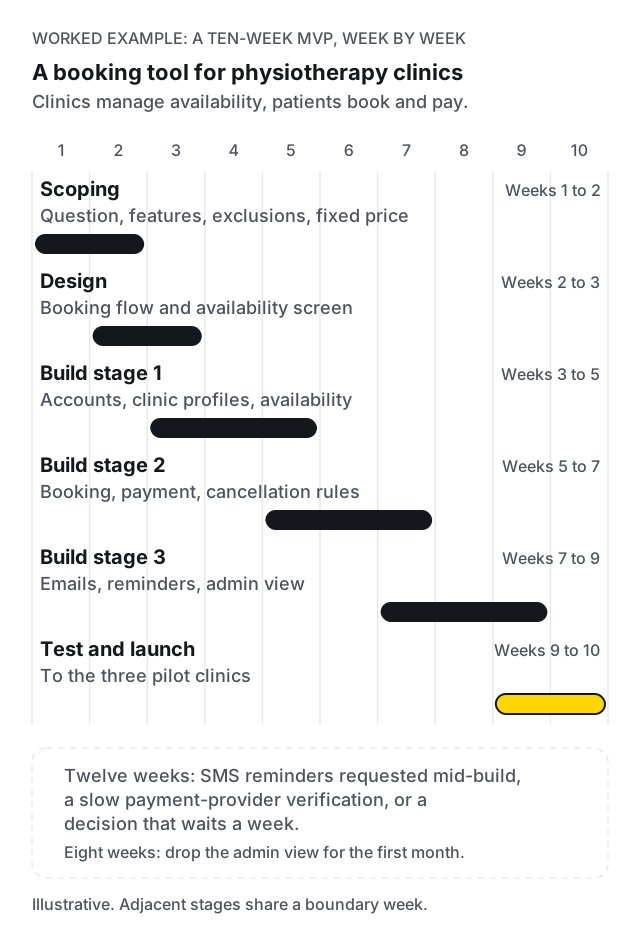
Worked example: a ten-week timeline
An illustrative B2B booking tool for physiotherapy clinics: clinics manage availability, patients book and pay, everyone gets email confirmations. It is a medium-to-large MVP.
Weeks
What happens
What the founder does
1 to 2
Scoping: the question, feature list, exclusions, flows, hosting plan, fixed price
Answers questions within a day; opens the Stripe account; recruits three pilot clinics
2 to 3
Design of the booking flow and the clinic's availability screen
Reviews screens with one pilot clinic
3 to 5
Build stage 1: accounts, clinic profiles, availability
Uses the staging site; sends the terms and privacy text
5 to 7
Build stage 2: booking, payment, cancellation rules
Tests bookings with real cards in test mode
7 to 9
Build stage 3: emails, reminders, admin view
Prepares onboarding emails for pilot clinics
9 to 10
Testing and launch to the three pilot clinics
Onboards the clinics personally
What would make it twelve weeks: a mid-build request for SMS reminders, a slow payment-provider verification, or a decision that waits a week. What would make it eight: dropping the admin view in favour of direct database access for the first month.
If you already have a prototype
If you built a first version with an AI app builder, your timeline may be shorter than a fresh build, or it may not. It depends on what is underneath. The Prototype Check costs €99: within 48 hours a person reviews the repository and the live app and sends you the top security and data risks in writing, followed by a 15-minute call. The €99 is credited against the build if you then hire us. The full five-day audit is described on the prototype to production page.
When a quick timeline means you should not hire an agency
- You need an answer in under two weeks. Test the idea without custom software: a landing page with a sign-up, a manual service behind a form, or a no-code tool. See agency vs freelancer vs no-code.
- You do not know yet what question you are testing. Spend a week talking to potential users first. It is free and it shortens everything that follows.
For what the weeks cost, read how much an MVP costs in Europe, or see how we run the work on the MVP development page.
Work with us
Need to know how many weeks your MVP really needs?
We are a Budapest team that builds MVPs for founders across Europe in four to twelve weeks. Send us a few lines on what you want to test, any deadline you are working to and anything already built, and we reply within one business day.
Start a conversation ↗ MVP Development
Recent builds
[
Nonstop Nanny · Childcare
Web MVP and SEO for a Babysitter Booking Platform
MVP
SEO
WordPress
WooCommerce
[
Easify AI · SaaS & AI
AI MVP Development for a Database Querying SaaS
MVP
WordPress
React


On this page
- At a glance
- How other estimates compare
- The phases, week by week
- Phase 1: scope (weeks 1 to 2)
- Phase 2: design (overlaps weeks 2 to 4)
- Phase 3: build in stages (weeks 3 to 10)
- Phase 4: test and launch (about 1 week)
- Phase 5: measure and decide
- Timelines by size
- Lead times outside anyone's control
- What slows MVP projects down
- Founder's week-one checklist
- How to go faster, honestly
- Worked example: a ten-week timeline
- If you already have a prototype
- When a quick timeline means you should not hire an agency
Frequently asked
How long does it take to build an MVP?
With Easify, typically four to twelve weeks from the start of scoping to a live product. A single-flow web app sits at the short end; a marketplace or a product with several integrations sits at the long end. Other published estimates run longer: Netguru says about three to four months.
Can an MVP be built in two weeks?
A clickable prototype or a no-code test can. A product with real accounts, payments and data that persists, built so it can be kept, rarely can. If two weeks is a hard limit, cut the scope to one flow or test the idea without software first.
How long does it take to build a mobile app MVP?
Longer than a web app, because of two platforms and store release. Apple says it typically reviews 90% of submissions in under 48 hours, but a new personal Google Play account must first run a closed test with at least 12 testers for 14 days before it can publish. Plan those weeks in from the start.
What is the biggest cause of MVP delays?
Usually not the development. It is scope that keeps changing, and waiting: for decisions, feedback, content, accounts and third-party approvals. A founder who answers within a day keeps the project moving.
How long should the discovery or scoping phase take?
For most MVPs, one to two weeks. Easify's MVP Scoping Sprint takes about two weeks, costs €900, and is credited in full against the build if you build with us. Longer than a month usually means the question has not been decided yet.
Does adding more developers make it faster?
Only up to a point. A small MVP has a limited amount of work that can happen in parallel, and every extra person adds coordination. Cutting scope is almost always faster than adding people.
Do AI coding tools make MVPs faster to build?
They make prototypes much faster, and they help experienced developers with routine code. They do not shorten the parts that usually set the timeline: deciding scope, waiting for decisions and approvals, and testing the paths that handle money and personal data.
What happens after the MVP launches?
A measurement period, usually a few weeks, while real users show whether the behaviour you are testing happens. Then you decide to build on it, change direction or stop, and the next round is planned from what you learned.
Keep reading
[
Edtech MVP Development: Buyers, Children's Data and Scope
[
Enterprise Ireland Funding for Startups Building an MVP
](https://easifytechnologies.com/enterprise-ireland-funding-for-startups/)
[
EU Funding for Startups: Can It Pay for Your MVP?
](https://easifytechnologies.com/eu-funding-for-startups-mvp/)


Want this done properly on your own site?