this page
- title ............
- MVP Agency vs Freelancer vs No-Code: Which to Choose | Easify Technologies
- human_version ....
- easifytechnologies.com/mvp-agency-vs-freelancer-vs-no-code/
- raw_markdown .....
- /mvp-agency-vs-freelancer-vs-no-code.md
for agents
- /llms.txt ................
- a short index of the site for language models
- /{page}.md ...............
- any page as markdown, e.g. /pricing.md or /index.md
- Accept: text/markdown ....
- request any page with this header and you get its markdown
- /machine/{page}/ .........
- this view: the same markdown, readable in a browser
content
A fair comparison of five ways to build an MVP: agency, freelancer, no-code, AI app builder or technical co-founder, with a decision guide and an example.
Source: https://easifytechnologies.com/mvp-agency-vs-freelancer-vs-no-code/
MVP Agency vs Freelancer vs No-Code: Which Should You Choose?
19 October 2026 Updated 20 October 2026 12 min read
There are five realistic ways to build an MVP: an agency, a freelancer, a no-code platform, an AI app builder, or a technical co-founder. No-code and AI app builders are the cheapest and fastest way to test whether people want something. A freelancer suits a narrow build you can manage yourself. An agency suits a product that needs design, engineering and project management together and has to survive being right. A technical co-founder is the best answer if the product is the company, and the slowest to find.
We are an agency, so read this knowing that. We have tried to be fair, and the "when each is right" section recommends the alternatives wherever they are honestly better. Below: a comparison table, each option in detail, a decision guide, a worked example of the same MVP built five ways, the hybrid paths most founders actually take, and how to protect yourself whichever you choose.
Work with us
Not sure which route fits your MVP?
Start a conversation ↗ MVP Development
At a glance
Cheapest way to test demand
No-code or an AI app builder, often with no developer at all
Best for a narrow, well-defined build
A good freelancer, if you can manage the project
Best when it must be kept and grown
An agency or a technical co-founder
Easify, for reference
€4,000 to €25,000, 4 to 12 weeks, €25 to €45 an hour
Other agencies, published estimates
€30,000 to €80,000 for a Berlin SaaS MVP; around $10,000 to $20,000 for a simple Eastern European MVP
Biggest risk across all five
Building more than the question needs
Protects you on every route
Code, accounts and data in your name from day one
The comparison
Agency
Freelancer
No-code
AI app builder
Technical co-founder
Upfront cost
Highest cash cost
Lower, varies widely
Low: a monthly subscription
Low: a monthly subscription
Equity, little cash
Time to a first version
Weeks
Weeks
Days to weeks
Hours to days
Weeks, once you find them
What you get
Design, build, testing, deployment, project management
Usually the build; design and testing vary
A working app on the platform
Generated code and a hosted app
A long-term owner of the technology
Code ownership
Yours, if the contract says so
Yours, if the contract says so
Usually tied to the platform
Exportable code, depending on the tool
Shared through the company
Scales with success
Yes, if built on proper foundations
Depends on the person
Limited by the platform
Needs hardening first
Yes
Main risk
Overbuilding, paying for scope you do not need
One person: illness, other clients, leaving
Lock-in and cost at scale
Security and data gaps hidden behind a working demo
Finding the right person, and a split if it goes wrong
Your time needed
Decisions and feedback
Decisions plus project management
Building it yourself
Building and testing it yourself
Running a company together
For the agency column, published market figures give a sense of range: Kolonell puts an agency-built SaaS MVP in Berlin at €30,000 to €80,000, Vamasters says a simple Eastern European MVP can start at around $10,000 to $20,000, and EltexSoft puts a focused MVP at $25,000 to $80,000. Each is one firm's estimate.
Freelance rates vary just as much. Affective, an app agency, puts freelancers at £20 to £40 an hour against £40 to £80 for agencies, and Altar.io expects senior European or Latin American freelancers at €60 to €120 an hour. Both are the authors' estimates, not surveys, and they show why "a freelancer is cheaper" depends on which freelancer.
Each option, honestly
Agency
Strengths: a team covering scope, design, engineering, testing and deployment; continuity if one person is away; someone accountable for the whole result. A good agency also argues for a smaller version one, which saves more money than any rate difference.
Weaknesses: the highest cash cost of the five. Agencies vary enormously, and a poor one will build whatever you ask for, including the parts you did not need. Our 12 questions to ask an MVP agency are designed to expose that.
Best for: a non-technical founder with a product of several moving parts and a budget in the thousands to tens of thousands.
Freelancer
Strengths: often a lower rate, a direct line to the person writing the code, and flexibility. A senior freelancer who has built similar products can be excellent value.
Weaknesses: you become the project manager. Design, testing and deployment may not be included, so check. And it is one person: if they get ill, take a bigger client or move on, the project stops. Make sure the code and every account are in your name from day one.
Best for: a founder who can write a clear one-page brief, review the work, and spend a few hours a week managing it. If you cannot write that brief yet, a freelancer will build their guess at it.
No-code platforms
Tools such as Bubble, Glide or Softr for apps, Sharetribe for marketplaces, or Webflow for sites, let a non-developer build a working product.
Strengths: cheap, fast, and you can change it yourself. For many ideas it is the right first step, because the question is whether anyone wants the thing, and no-code can answer it. Pricing is a subscription you can see in advance: Sharetribe, for example, lists its Build plan at $39 a month and its Live plan at $259 a month, or $199 billed annually, with usage billed separately.
Weaknesses: you build on someone else's platform. Most no-code tools do not let you export the application as code you can run elsewhere, so check before you invest. Pricing that is cheap at a hundred users can be expensive at ten thousand, and when you need something the platform does not support, the usual answer is a rebuild.
Best for: testing demand for a product that is mostly forms, lists, listings and workflows.
AI app builders
Lovable, Bolt, v0 and Replit generate a working application from a description, with real code underneath.
Strengths: remarkably fast at producing something you can click, show and test with users. For validating an idea, they are a real step forward, and you can often export or sync the code. Our Lovable vs Bolt vs v0 comparison goes through stack, hosting, EU data and lock-in for each.
Weaknesses: they are optimised for the version that convinces someone, not the version that holds real data and money. The failure patterns are well documented: authorisation checked in the browser rather than on the server, database rules left open, API keys in client-side code, queries that work at ten rows and fail at ten thousand, no migrations and no tests. None of that is visible in a demo. If you go this route, have the code reviewed before real users arrive. Our guides to taking a Lovable app to production and the Prototype Check cover what to look for.
Best for: a clickable product in days, for investors or early users, accepted as a prototype.
Technical co-founder
Strengths: someone who owns the technology for the long term, makes decisions with you, and is paid in equity rather than cash. Investors often look for one.
Weaknesses: finding the right person can take months, and the wrong one is far more expensive than any agency. Equity is the most valuable thing you have, so agree roles and vesting in writing before any code is written.
Best for: a product that is the company, with years of engineering ahead.
A decision guide in six questions
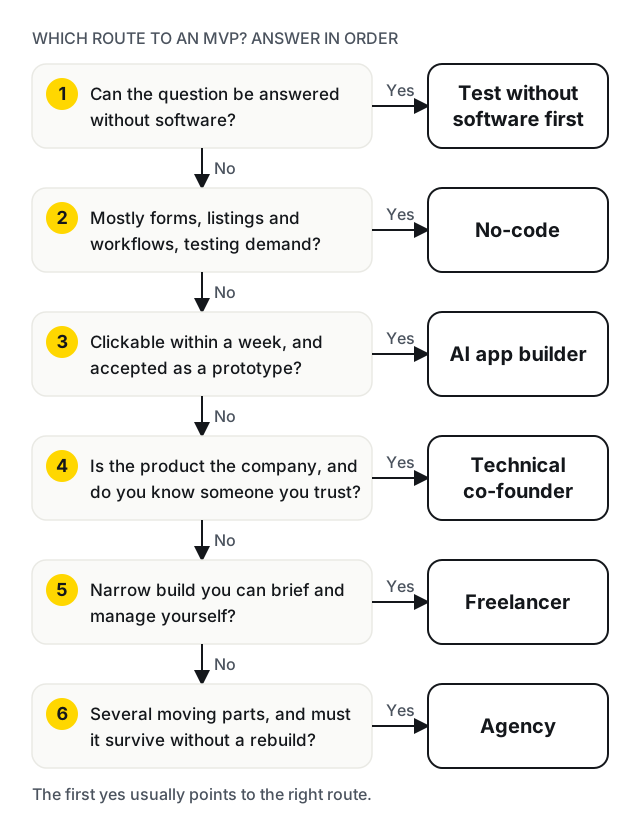
Answer these in order. The first "yes" usually points to the right route.
- Can the question be answered without software? A landing page with a sign-up, a manual service behind a form, a concierge test by email. If yes, do that first. It costs days, not thousands.
- Is the product mostly forms, listings and workflows, and are you testing demand rather than technology? If yes, start with no-code.
- Do you need something clickable within a week, to show investors or early users, and accept that it is a prototype? If yes, use an AI app builder, and plan a review before it holds real data or money.
- Is the product the company, with years of engineering ahead, and do you know someone you trust? If yes, look for a technical co-founder, and consider building a first version another way while you do.
- Is the build narrow, and can you write a one-page brief and manage the work yourself? If yes, a good freelancer.
- Does it have several moving parts (two-sided booking, payments, an AI feature, integrations), and must it survive success without a rebuild? If yes, an agency.
Worked example: one MVP, five ways
The same idea, built five ways: a booking tool for independent physiotherapists, where patients pick a slot, pay and get reminders. The figures are illustrative, to show how the trade-offs play out, not quotes or market data.
Route
What you would get
Cash
Your time
Main risk for this product
No-code booking tool
A working booking page with payments on the platform
A monthly subscription
Building and configuring it yourself
Hits the platform's limits on custom rules, such as clinic-specific cancellation fees
AI app builder
A convincing app in days, with real code
A monthly subscription, plus a review before launch
Prompting, testing and fixing
Patient data protected only in the browser; double bookings under load
Freelancer
A custom app, scope depending on the brief
Their hours at their rate
Managing the work several hours a week
Design and testing left out; one person between you and launch
Agency (Easify)
Scope, design, build, testing and deployment, in about 8 to 10 weeks
In the region of €10,000 to €18,000 at our rates
Decisions and feedback
Paying for more than the question needs, if the scope is not cut
Technical co-founder
The same custom app, built by someone with a stake in it
Little cash, a share of the company
Running a company together
Months to find the right person
For this product, a sensible path is a no-code or manual test with three clinics, then a custom build once clinics are paying. That is a combination, which is how most founders end up doing it.
The hybrid paths most founders take
The five options are not exclusive. Common combinations that work:
- No-code or AI prototype, then a proper build. Test interest with a prototype, then build the real product once there is a signal. The prototype is not wasted: it shows exactly what the real product needs.
- Agency for version one, then an in-house hire. An agency builds the MVP on standard foundations with documentation, and your first engineer takes it over. Insist on a handover in the contract.
- Agency for architecture, freelancers for features. Someone accountable sets up the foundations, and smaller, well-defined pieces go to freelancers later.
- Build a first version to recruit a co-founder. A working product with a few users is a stronger pitch to a potential technical co-founder than an idea.
- Prototype check before any of it. If you already have something built with Lovable, Bolt or v0, find out what is underneath before you choose a route. Our Prototype Check costs €99, takes 48 hours, and is credited against the build if you then build with us.
Protect yourself, whichever route you choose
These apply to every option:
- Everything in your name. The code repository, hosting, domain, database, payment provider, app store accounts and analytics, created by you or transferred before launch.
- A written transfer of the code. Under EU law, when an employee writes software in the course of their duties, the employer is entitled to exercise the economic rights in it (Software Directive 2009/24/EC, Article 2(3)). A freelancer or agency is not your employee, so the contract should transfer the code, designs and documentation to your company.
- Code pushed to your repository often. Weekly at least, so nothing exists only on someone else's laptop.
- A written scope with exclusions, whoever builds it.
- Exportable data. On no-code and AI builders, check how you get your data out before you put users' data in.
- A data processing agreement with anyone who handles your users' personal data on your behalf, as the GDPR requires (Article 28).
- A review before real data or money. Especially for AI-generated code.
When each is right
Choose no-code when you are testing demand, the product is mostly forms, lists and workflows, your budget is under a few thousand euros, and you are happy to rebuild if it works. This is the honest answer for many first-time founders.
Choose an AI app builder when you want a clickable product in days to show investors or early users, and you accept that it is a prototype. Plan for a review and hardening step before it holds real data or takes payments.
Choose a freelancer when the build is narrow and well defined, you have time to manage it, and you can find someone who has built something close to it before. Check references and own every account.
Choose an agency when the product has several moving parts (two-sided booking, payments, an AI feature, several integrations), when you need design and engineering together, when you do not have time to manage developers, or when the MVP needs to survive success without a rebuild.
Choose a technical co-founder when the product is the company and will need engineering for years, and you have found someone you trust. Many founders do both: build a first version another way, and use it to recruit the co-founder.
When to hire us, and when not
Hire us if you have a defined question to test, a budget in the region of €4,000 to €25,000, and you want something live in four to twelve weeks, built on foundations you can keep, and hosted in the EU. We are in Budapest, work on CET in English or Hungarian, and our engineering team is in India. We start with the MVP Scoping Sprint: €900, about two weeks, a written scope and a fixed build price, credited in full against the build if you build with us. See MVP development for how we run it, what an MVP costs for the detail behind the numbers, and how long it takes for the weeks.
Do not hire us if your budget is under €1,000, our minimum project; if no-code would answer your question; or if you need a developer in your office every week. If you already have an AI-built prototype, start with the €99 Prototype Check rather than a new build.
Work with us
Not sure which route fits your MVP?
We are a Budapest team that builds MVPs for founders across Europe, and we will tell you if no-code or a freelancer would serve you better. Send us a few lines on what you want to test, your budget and any deadline, and we reply within one business day.
Start a conversation ↗ MVP Development
Recent builds
[
Nonstop Nanny · Childcare
Web MVP and SEO for a Babysitter Booking Platform
MVP
SEO
WordPress
WooCommerce
[
Easify AI · SaaS & AI
AI MVP Development for a Database Querying SaaS
MVP
WordPress
React
[
Meetlyr · SaaS & AI
Product Design and Build for a Social Discovery App
UI/UX
WordPress
React


On this page
- At a glance
- The comparison
- Each option, honestly
- Agency
- Freelancer
- No-code platforms
- AI app builders
- Technical co-founder
- A decision guide in six questions
- Worked example: one MVP, five ways
- The hybrid paths most founders take
- Protect yourself, whichever route you choose
- When each is right
- When to hire us, and when not
Frequently asked
Should I use an agency, a freelancer or no-code for my MVP?
Use no-code or an AI app builder to test demand cheaply and quickly. Use a freelancer for a narrow, well-defined build you can manage yourself. Use an agency when you need design, engineering and project management together and want the MVP built so it can be kept.
Is no-code good enough for an MVP?
Often, yes. If the question you are testing is whether people want the thing, a no-code tool can answer it for a fraction of the cost of custom code. The limits show up later: platform lock-in, cost at scale, and features the platform does not support.
Can I launch an app built with Lovable or Bolt?
You can launch a demo with it, and many founders do to test interest. Before real users store real data or pay, have someone check the well-known weak points: authorisation checked only in the browser, open database rules and API keys in client-side code.
Should I find a technical co-founder instead of paying for an MVP?
If the product is the business and will need engineering for years, a committed technical co-founder is worth more than any agency. Finding the right one takes time and costs equity, so many founders build a first version another way while they look.
Is a freelancer cheaper than an agency for an MVP?
Often on rate, not always in total. A freelancer usually does not include design, testing or project management, and if they become unavailable the project stops. Compare what is included, and count your own hours managing the work, not only the hourly figure.
What happens if my freelancer disappears mid-project?
If the code, hosting and every account are in your name, another developer can pick it up, with some lost time while they learn it. If they are in the freelancer's name, you may have to start again. Set that up on day one, and ask for the code to be pushed to your repository at least weekly.
Can I start with no-code and move to custom code later?
Yes, and it is a sensible path. Treat the no-code version as a prototype that tells you what the real product needs. Most no-code platforms do not export an application you can run elsewhere, so plan for a rebuild rather than a migration, and keep your data exportable.
Who owns the code if a freelancer or agency writes it?
Whoever the contract says. EU law gives employers the economic rights in software their employees write, but a freelancer or agency is not your employee, so the contract should transfer the code and designs to your company explicitly.
Keep reading
[
Edtech MVP Development: Buyers, Children's Data and Scope
[
Enterprise Ireland Funding for Startups Building an MVP
](https://easifytechnologies.com/enterprise-ireland-funding-for-startups/)
[
EU Funding for Startups: Can It Pay for Your MVP?
](https://easifytechnologies.com/eu-funding-for-startups-mvp/)

Want this done properly on your own site?