MVP Development
MVP development that answers one question with real users. Scoped in weeks, built properly enough to keep, and honest about what to leave out.

At a glance
| Typical price | €5,000 to €25,000, fixed after a written scope. Rate €25 to €45 an hour, €1,000 minimum. Estimate yours |
| First step | The MVP Scoping Sprint: about two weeks, €900 fixed and credited in full against the build, and you get the written scope and a fixed price |
| Typical timeline | 4 to 12 weeks from signed scope to live product |
| What you get | A working web or mobile product with real users, the code and accounts in your name, and a written view of what the first users taught you |
| Stack | Next.js, React, TypeScript, Laravel, PostgreSQL, Stripe, Vercel |
| Hosting | In the EU: we deploy client products to EU data-centre regions |
| Industries | Any, including regulated ones such as fintech and healthtech |
| Team | Based in Budapest, working remotely across Europe on Central European Time; engineering in India. English or Hungarian |
| Built before | A babysitter booking platform, an AI database-querying SaaS, a marketplace for digital businesses, a home-services SaaS |
| Already have an AI-built prototype? | Start with the €99 Prototype Check |
| To start | Tell us what you need to learn from the first version and who it is for. We reply within one business day |
What an MVP is for
To find out whether people want the thing, before you have spent everything finding out.
That sounds obvious and it is routinely ignored. Most first versions we are asked to quote are not minimum or viable; they are the whole product with a smaller budget attached. So the first conversation is usually about subtraction, and it is the most valuable part of the engagement even though it looks like we are talking you out of work.
The question that shapes everything
Before scope, before design, before anything technical: what do you need to learn, and what result would change what you do next?
"Will restaurant owners pay monthly for automated rota scheduling" is a question. It tells us the MVP needs rota building, an invitation flow for staff, and a subscription. It also tells us it does not need reporting, integrations, or a settings page, because none of those change the answer.
"Build a restaurant management platform" is not a question, and a project scoped from it will run for a year.
How we work
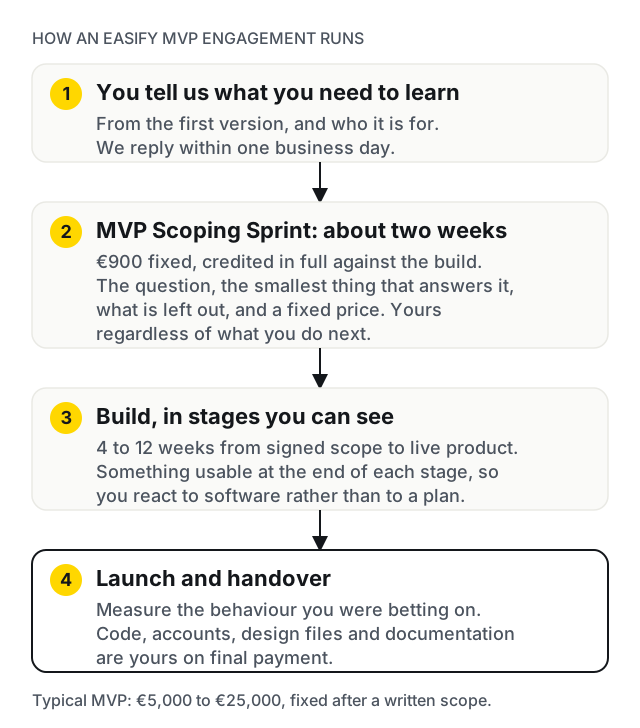
Weeks one and two, scope. The question, the smallest thing that answers it, and what we are deliberately leaving out. Written down, fixed price, and yours regardless of what you do next. This is the €900 Scoping Sprint, and you can book it on its own.
Then build, in stages you can see. Something usable at the end of each, so you are reacting to software rather than to a plan. This is also where scope creep gets caught, because a new idea is visibly a change to something real.
Launch, then measure the thing we agreed to measure. Not vanity metrics. Whether the specific behaviour you were betting on actually happens.
What you will own
The code, the accounts, the design files, and documentation good enough for another team to pick it up. On final payment, all of it is yours. We have had clients take an MVP in-house after launch and that is a perfectly good outcome.
Being straight about the odds
Most MVPs do not become businesses. That is not a failure of the build, it is what testing an idea means, and a well-scoped MVP that returns a clear no has done its job at a fraction of the cost of finding out later.
We would rather you spent a small amount on a clean answer than a large amount on a hopeful one.
Guides for founders
- How much does an MVP cost in Europe?, or estimate yours
- How long does it take to build an MVP?
- How to choose an MVP development agency: 12 questions
- Agency, freelancer, no-code or a technical co-founder?
- Grants and public funding for an MVP, country by country
- By product: marketplace, booking platform, AI product, SaaS
How it works
- One question, chosen before anything is built
- A minimum viable product is an experiment, and an experiment without a question is just a small product. We start by agreeing what you are trying to find out and what answer would change your plans. That decides the scope, and it is the only thing that reliably keeps an MVP small.
- Ruthless about what is not in it
- Most of what founders want in version one exists because a competitor has it. Admin panels, settings pages, tiered permissions and onboarding flows can almost always wait. We will argue for cutting things, we will tell you why, and the decision stays yours.
- Real enough to charge for
- Working payments, real accounts, data that persists. The point is a genuine signal, and people behave differently when a card is involved. A prototype that cannot take money answers a much weaker question.
- Built so it can survive being right
- The failure we see most often is an MVP that works, finds its market, and then has to be thrown away because it was built as a demo. We use the same foundations as any other project: version-controlled migrations, server-side authorisation, a real deploy. It costs a little more in week one and it is the difference between scaling and starting again.
- Weeks, and then a decision
- A typical MVP with us is four to twelve weeks depending on scope. At the end you have something live, real usage data, and a written view of what we learned. Then you decide whether to build on it, change direction, or stop. Stopping is a legitimate outcome and it is much cheaper here than a year later.


What is and is not included
Included
- A written scope naming the one question the MVP answers
- What is deliberately left out, and why
- Working payments, real accounts, data that persists
- The same foundations as any other build, so it can be kept
- Something usable at the end of each stage
- Measurement of the specific behaviour you are betting on
Not included
- Features that do not change the answer to the question
- Marketing, launch and paid acquisition
- Ongoing hosting and third-party service costs
- A second direction after the first is built, which is a new scope
What we build it with
- Next.js
- React
- Laravel
- PostgreSQL
- Stripe
- TypeScript
- Vercel
What does an MVP cost?
How long does it take?
What should be in version one?
Will it survive if it works?
Do we own it?
What if the answer is no?
Tell us what you are trying to ship.
Start a conversation ↗