Marketplace MVP Development: What to Build First

A marketplace MVP has one job: get a real buyer and a real seller through one transaction, safely, in one narrow niche. With Easify that typically takes 6 to 12 weeks and costs €12,000 to €25,000 for a two-sided web marketplace with working payments, which sits at the top of our usual €4,000 to €25,000 MVP range because a marketplace has two sets of users and money moving between them. The hard part is rarely the features. It is getting supply in before demand arrives, and getting strangers to trust each other enough to pay.
This guide covers the chicken-and-egg problem, the marketplace models and their hard parts, which features to build first, whether to build or use a hosted platform, how payments and escrow work, what trust and safety needs on day one, the metrics to track, a launch plan, a typical scope and price, and the pitfalls specific to marketplaces.
If you want a fixed price for your own marketplace, our MVP Scoping Sprint produces a written scope and a build price in about two weeks for €900, credited in full against the build if you build with us.
At a glance
| Question | Answer |
|---|---|
| Typical price with Easify | €12,000 to €25,000 for a transactional marketplace; from about €4,000 for a lean, partly manual one. Illustrative, not a quote |
| Timeline | 6 to 12 weeks |
| Included | Seller onboarding and listings, buyer search and checkout, payments and payouts, moderation, email notifications, an admin view |
| Usually left out | Native apps, wallets, auctions, multi-currency, ranking algorithms, referral schemes |
| Suits | Founders who can seed the supply side themselves in one niche or city |
| Not a fit yet | No plan for the first 20 sellers, or no transactions done by hand |
| To get started, send | The niche, who is on each side, how you will recruit the first sellers, how money should move, and your deadline |
The chicken-and-egg problem comes before the software
Buyers come for choice and sellers come for buyers. Neither turns up first on its own, and no feature list changes that. What the MVP can do is make one side easier to seed.
- Pick the side to seed, usually supply. A buyer who lands on an empty catalogue leaves and rarely returns. A seller who lists and waits a few weeks is more patient, especially if you recruited them personally.
- Shrink the market until it can look full. One category, one city, one type of buyer. Fifty listings in one niche feels like a market; fifty spread across ten categories feels like a ghost town.
- Be the supply, or broker by hand. Many marketplaces started with the founders sourcing listings themselves, or matching buyers and sellers over email before any matching code existed. That is not cheating; it is how you learn what a good match looks like.
- Give one side a reason to use it alone. A listing tool, a valuation, a booking calendar: something a seller gets value from before any buyer arrives.
- Set a liquidity target before you launch the demand side. For example: at least 30 live listings, each answered within a day. Only then spend money on buyers.
If you cannot get the first ten transactions done manually, with a form, a spreadsheet and a payment link, the software will not get them done either. We would rather tell you that before a build than after one.
Choose the marketplace model before the features
The kind of marketplace sets most of the scope. Decide which one you are building, because each has a different hard part.
| Model | What changes hands | Examples of the type | The hard part in an MVP |
|---|---|---|---|
| Products, business to consumer | Physical goods from shops or makers | Craft, second-hand, specialist retail | Shipping, returns and seller fulfilment |
| Products, consumer to consumer | Goods between private people | Used items, collectibles | Trust between strangers, disputes, fraud |
| Services | Time and skill | Tutoring, repairs, cleaning, freelance work | Scheduling, quality, and leakage off the platform |
| Rentals and bookings | Use of something for a period | Equipment, spaces, stays | Availability and deposits; see the booking platform guide |
| Business to business | Bulk goods or services between companies | Wholesale, industrial supplies, logistics | Invoicing, payment terms, negotiated prices |
| Digital assets | Ownership of something online | Websites, apps, domains, channels | Verification and a safe transfer of ownership |
Decide the revenue model at the same time. A commission on each transaction, a subscription for sellers, a listing fee, a buyer fee, or a mix. A commission only works if the transaction happens on the platform, which makes payments part of version one. A seller subscription can work with payment by link, which makes the first build smaller.
Which features to build first
Build in the order a single transaction happens, and stop when one transaction can complete end to end.
- Seller onboarding and listing creation. A listing in a fixed structure, with the three or four attributes buyers actually choose by. Free-text listings cannot be compared or filtered.
- Buyer browse and search. Filters on those same attributes. Full-text search and ranking can wait until there are enough listings to rank.
- A listing page that answers the buyer's questions. Price, what exactly is being sold, who the seller is, and what happens after paying.
- Contact or enquiry. An email relay or a simple message thread. Real-time chat is rarely what decides whether the first deals happen.
- Checkout, payment and payout. The buyer pays the platform's provider, the seller is paid out, and the platform keeps its commission.
- Moderation and an admin view. Approve listings before they go live, see every transaction, refund one when needed.
- Transactional emails. New enquiry, payment received, payout sent, listing approved.
Reviews and ratings belong in version one only if the transactions are frequent enough to generate them. With ten deals a month, a review system shows mostly empty stars.
Minimum feature set checklist
- Sign-up and sign-in for both sides, with authorisation checked on the server
- Seller profile and verification step appropriate to the risk
- Structured listing form with photos or documents
- Listing moderation queue: nothing goes live unapproved
- Browse and filter on the attributes buyers choose by
- Listing detail page with seller information and terms
- Enquiry or messaging between the two sides
- Checkout through a marketplace payments provider, with commission
- Seller payouts, with a hold period if the deal needs one
- Refund and dispute handling, even if it is manual at first
- A "report this listing" link that reaches a person
- Transactional emails for every state change
- Admin view of users, listings and transactions
- Terms of service, privacy policy and seller terms
Build or buy the platform
Not every marketplace MVP needs custom code. Hosted marketplace platforms give you listings, search, accounts and checkout for a monthly fee. Sharetribe, for example, lists its Build plan at $39 a month, and its Live plan at $259 a month or $199 billed annually, with usage billed separately.
| Hosted marketplace platform | Custom build | |
|---|---|---|
| Time to launch | Days to weeks | 4 to 12 weeks with Easify |
| Upfront cost | A monthly subscription | €4,000 to €25,000 with Easify, illustrative |
| Fits | Standard listings, search and checkout | A model the platform cannot express |
| Verification and trust | What the platform offers | Designed around your risk |
| Payments | The platform's integration | Your choice of provider and charge type |
| Later | Platform limits and fees as you grow | You own the code and the roadmap |
Buy when your model is standard and the open question is demand. Build when the thing that makes your marketplace different (how sellers are verified, how buyers and sellers are matched, how money is held and released) is exactly what a hosted platform cannot do. Many founders do both in sequence: test on a hosted platform, then build once the model is proven and its limits are clear.
Payments and escrow
Money is where marketplaces get complicated, and where shortcuts become expensive.
Use a marketplace payments product. Stripe Connect is the common choice; Mangopay and Adyen for Platforms do similar jobs. They onboard sellers, run identity checks on them, split the payment between the seller and your commission, and pay sellers out. The alternative, collecting buyers' money into your own account and paying sellers later, can make you a payment service provider under the EU's payment services rules. Take advice before going near that, and in an MVP, simply avoid it.
Know who carries refunds and chargebacks. Depending on the charge type you choose, a refund or a chargeback can come out of the platform's balance rather than the seller's. Stripe's documentation on charge types sets out which is which. Choose deliberately, because it decides who absorbs the loss when a deal goes wrong.
Escrow, in practice, is a hold. For most marketplaces "escrow" means the buyer pays now, the seller is paid out only after delivery is confirmed or a set period passes without a dispute. Stripe Connect supports this with manual or delayed payouts. For high-value, slow transactions such as buying a business, a dedicated escrow service can be simpler than building the hold logic yourself.
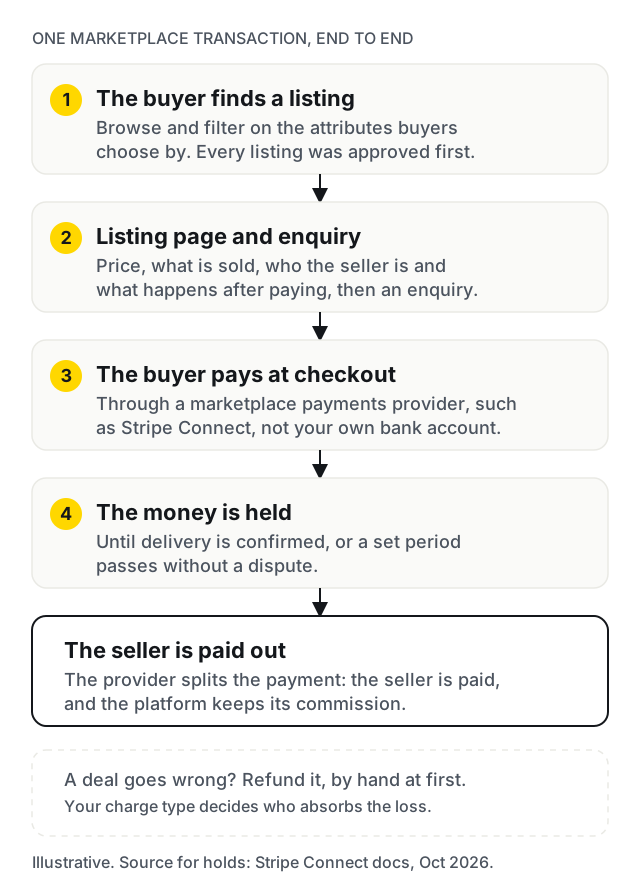
Decide your commission model early. Percentage on the buyer, on the seller, or split; a listing fee; a subscription for sellers. It changes the checkout, the payout maths and the seller terms, so it is a scope decision, not a setting.
Trust and safety on day one
A marketplace asks strangers to send each other money. Trust is operational work, and the MVP needs the minimum of it from the first transaction.
- Verify sellers in proportion to the risk. An email address is enough for second-hand books. For anything high-value, sellers should pass identity checks before they can list or be paid. Payments providers run identity checks as part of seller onboarding, which covers much of this.
- Moderate before publishing. In an MVP, a person approving every new listing is cheap, fast and catches most bad actors. Automate it later, when the volume justifies it.
- Make reporting easy and act on it. Under the EU's Digital Services Act, services that host user content need a way for people to report illegal content (Article 16), and marketplaces take on further duties about traders as they grow. A report link that creates a ticket for a person is a small build.
- Only count reviews from completed transactions. Otherwise the first fake review arrives before the first real one.
- Write down what happens when a deal goes wrong. Refund rules, dispute window, who decides. A clear policy, applied by hand at first, does more for trust than any badge.
Metrics that tell you it is working
A marketplace MVP is a test of whether transactions happen. Track a handful of numbers from the first week, as named events, rather than a dashboard of everything.
| Metric | What it tells you | How to measure it |
|---|---|---|
| Listing liquidity | Whether supply is finding demand | Share of live listings that get an enquiry or sale within a set period, such as 30 days |
| Search-to-transaction rate | Whether buyers find what they came for | Share of buyer sessions with a search that end in an enquiry or purchase |
| Time to first transaction | How long a new seller waits for value | Days from a seller's first listing to their first sale |
| Repeat rate | Whether buyers come back | Share of buyers who transact a second time within a set period |
| Net take rate | What the marketplace actually earns | Commission kept, after payment fees, refunds and chargebacks, divided by transaction value |
| Leakage signals | Whether deals are moving off-platform | Enquiries that never become a transaction, contact details in messages |
There are no universal targets for these. The useful comparison is your own numbers week on week, in one niche, before you widen it.
A launch plan, step by step
- Broker ten transactions by hand. A form, a spreadsheet and payment links. Write down every question each side asked.
- Pick the niche and the side to seed. Usually supply, in one category or city.
- Scope the MVP around one transaction. The feature order above, the payment model, the trust minimum.
- Recruit the first sellers while it is being built. Personally, by phone or in person. Aim for enough listings that a buyer can choose.
- Launch to sellers first. Let them list, and fix what confuses them, before any buyer arrives.
- Open the demand side in the niche. Only when the liquidity target is met.
- Measure for a few weeks, then decide. Widen the niche, deepen the product, or change the model.
Typical scope and price
These are illustrative ranges inside our €4,000 to €25,000 MVP band, not a quote. Use the MVP cost calculator for your own scope, and see pricing for our rates.
| Scope | What it includes | Price | Time |
|---|---|---|---|
| Lean marketplace | Listings, enquiry, admin approval; payment by link, payouts by hand | €4,000 to €9,000 | 4 to 6 weeks |
| Transactional MVP | Both sides with accounts, filters, Stripe Connect checkout and payouts, moderation, emails | €12,000 to €20,000 | 8 to 10 weeks |
| With verification and holds | The above plus seller identity checks, delayed payouts, a dispute flow, reviews | €18,000 to €25,000 | 10 to 12 weeks |
For comparison, Vamasters estimates a simple MVP built in Eastern Europe at about $10k to $20k and a mid-range one at $25k to $60k (Vamasters). That is one source's estimate, and marketplaces tend to sit towards the upper end of any MVP range.
Pitfalls specific to marketplaces
- Launching both sides at once. Spending on buyer acquisition before the catalogue is credible burns the budget on visitors who see nothing to buy.
- Going too broad. "A marketplace for services" is ten marketplaces. Pick one.
- Building the payment hold last. Retrofitting delayed payouts and refunds onto a live checkout is harder than designing them in, and it touches money that is already moving.
- Treating moderation as a later feature. One scam listing in the first month can end the marketplace's reputation in its niche.
- Unstructured listings. If sellers type whatever they like, buyers cannot compare and filters cannot work.
- Ignoring leakage. Buyers and sellers will try to finish the deal off-platform. Make the platform worth staying on (protection, paperwork, reviews) rather than relying on blocking contact details.
- Building a ranking algorithm with 40 listings. Sort by newest until there is something to rank.
Case study: Dealtous
Dealtous is a marketplace for buying and selling digital assets, including websites, SaaS products, mobile applications, domains, newsletters and online stores. We designed and built it on Next.js.
Its own case study puts the problem plainly: Dealtous asks people to buy a business they cannot walk into, so every part of the product turns on trust. Verification came first. Sellers publish through a workflow that checks who they are before a listing goes live, and listings carry pricing, analytics, revenue data, screenshots and supporting documents in a fixed shape, so two businesses can actually be compared. Buyers get advanced filters to narrow the catalogue, purchases run through an integrated payment system with protection on it, and listing moderation and account management sit behind all of it.
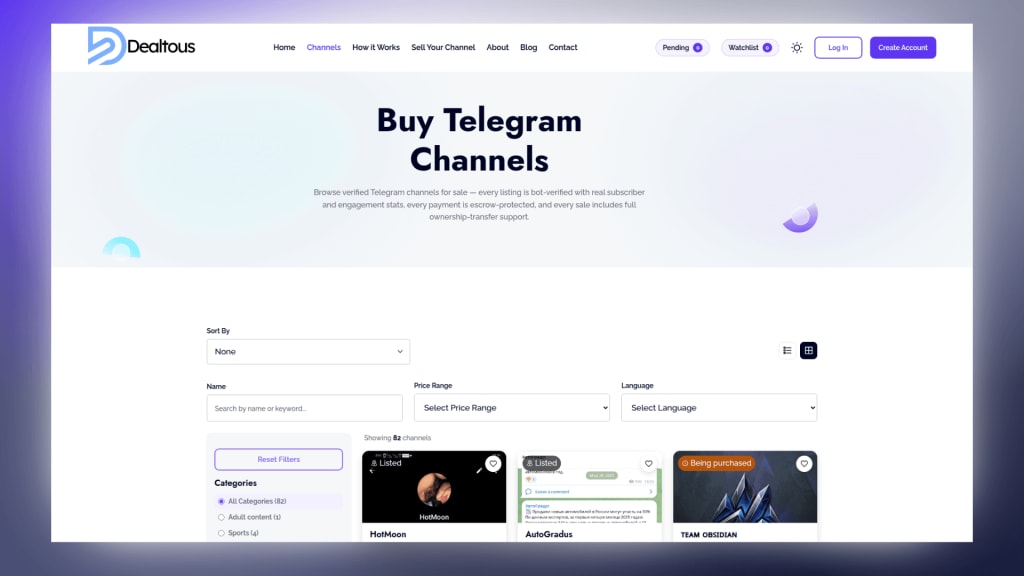
The listing page carries the trust signals next to the price: a verification status, a score summarising engagement, risk level and growth, buttons to add to cart or compare, and a note that payments are held in escrow until the buyer confirms the transfer.

That is the order this guide recommends for any marketplace where the stakes are high: trust and structure first, then discovery, then a protected transaction.
When not to hire us
- You have not brokered a single deal by hand. Do that first. It costs almost nothing and tells you more than an MVP.
- An off-the-shelf marketplace tool would answer your question. If your marketplace is a standard listings-and-checkout model, a hosted marketplace builder can test demand for a monthly fee. Come to us when the model outgrows it, or when the thing that makes your marketplace different is exactly what the tool cannot do.
- You need a full platform on day one. If investors or partners require native apps, multi-currency and every category at launch, that is a larger project than an MVP, and our MVP development service is deliberately not built for it.
If your marketplace is SaaS for one side of the market, read the SaaS MVP guide; if the transaction is a time slot rather than a product, the booking platform MVP guide covers availability and deposits.
Work with us
Need one niche, one transaction and one marketplace that works?
We are a Budapest team that builds marketplace MVPs for founders across Europe, working remotely on CET. Send us the niche, who is on each side, how you will get the first sellers and how money should move, and we reply within one business day.

Frequently asked