How Much Does an MVP Cost in Europe?

An MVP built by an agency in Europe costs anywhere from about €4,000 to €80,000, and where yours lands depends mostly on how much you put in it and who builds it. At Easify, a typical MVP costs €4,000 to €25,000 and takes four to twelve weeks, at €25 to €45 an hour. Published estimates for Western European agencies sit higher, and the gap is mostly rate, not effort.
If you want a number for your own idea rather than a range, try the MVP cost calculator. It asks what the product does and gives you an estimate in Easify's terms, with the hours behind it. If you want a fixed price rather than an estimate, the brief template further down is what any agency needs from you first.
At a glance
| Easify MVP price | €4,000 to €25,000, typically |
| Easify rate | €25 to €45 an hour, €1,000 minimum project |
| Easify timeline | 4 to 12 weeks |
| Market estimates | $10k to $20k (simple, Eastern Europe) up to €30k to €80k (agency SaaS MVP, Berlin) |
| Biggest price driver | The number of user types, features and integrations in version one |
| Not in the build price | Hosting, third-party services, store fees, marketing, ongoing maintenance |
| To get a fixed price | A written brief, then a scope: our MVP Scoping Sprint is €900, credited in full against the build if you build with us |
| Paying for it | Savings, angels, pre-seed, or a grant or voucher where one fits: see MVP grants and funding in Europe |
Easify's band next to the market
Three published estimates, each one firm's own view of the market:
- Vamasters (Eastern Europe): a simple MVP can start at around $10,000 to $20,000, with a mid-range MVP at $25,000 to $60,000.
- Kolonell (Berlin): an agency-built SaaS MVP at €30,000 to €80,000 over 10 to 16 weeks, in its 2026 estimate.
- EltexSoft: a focused MVP at $25,000 to $80,000.
Wider guides from agencies outside Europe give similar shapes. SoftTeco puts a simple MVP at $5,000 to $15,000, an average one at $15,000 to $45,000 and a complex one from $45,000, and RaftLabs puts a basic single-platform MVP at $10,000 to $20,000 and a full-featured one at $20,000 to $40,000.
Easify's band, €4,000 to €25,000, overlaps the bottom of those ranges and sits well below the Berlin figure. The reason is the rate rather than a smaller product. We are based in Budapest, the people you talk to are in Budapest and work on CET, and the engineering team is in India. That combination is what makes €25 to €45 an hour possible.
Read the ranges with care. Every firm defines "MVP" a little differently, and a range is only useful once you know what is inside it. Some include discovery, design, testing and deployment; some quote development alone.
Rates by region and team type
An MVP's cost is hours multiplied by a rate, so the rate matters as much as the scope. Two published views of hourly rates, in US dollars:
| Region | SoftTeco's range | RaftLabs' range |
|---|---|---|
| North America | $50 to $200 | $80 to $150 |
| Western Europe | $50 to $200 | $60 to $120 |
| Eastern Europe | $30 to $100 | $40 to $80 |
| India and South-East Asia | $15 to $60 (Asia and Africa) | $25 to $55 |
Sources: SoftTeco and RaftLabs. Both are vendors' estimates, not surveys.
Rate is only half the comparison. The same MVP costs a different total depending on who builds it:
| Who builds it | What the rate usually covers | What you add on top |
|---|---|---|
| Western European agency | Scope, design, build, testing, deployment, project management | Little, at the highest rate |
| Nearshore or offshore agency | Usually the same list, at a lower rate | Your time on communication, if time zones and language do not line up |
| Freelancer | Usually the build only | Design, testing, project management, and cover if they are unavailable |
| No-code or AI app builder | A monthly subscription | Your own time, and a rebuild or hardening step if it works |
For the trade-offs between these, read agency vs freelancer vs no-code.
What actually moves the price
The rate is the agency's; the hours are mostly yours to decide. These are the things that add hours:
- The number of user types. A product used by one kind of person is one set of screens and permissions. A marketplace with buyers, sellers and an admin is three.
- Integrations. Payments, calendars, maps, a CRM, an AI model, an accounting system. Each one is real work to build, and each is a thing that can break later.
- Native mobile apps. A responsive web app is one codebase. iOS and Android apps add store review, device testing and release management. If you can test the idea on the web first, you usually should.
- Custom design. A clean interface built from a proven component library costs far less than a bespoke visual identity. Early users forgive plain; they do not forgive broken.
- Admin and reporting. Founders often ask for a dashboard on day one. For the first few weeks, a spreadsheet export or direct database access is often enough.
- Compliance. Health, finance and children's data bring requirements that add work before the first user signs up. If your product sits in one of those areas, say so early.
- Unclear scope. The most expensive MVP is the one whose scope keeps moving. A written list of what is in and, just as important, what is out is the cheapest thing you can buy.
The single most effective way to reduce the price is to decide what question the MVP has to answer, then cut everything that does not change the answer. That is how our MVP development work starts.
Cost by type of MVP
The type of product sets the starting point. Each of these guides has its own illustrative price table:
| Type | Typical Easify range (illustrative) | Why |
|---|---|---|
| SaaS, single user | €4,000 to €10,000 | One user type, one workflow, one plan |
| SaaS for teams | €12,000 to €25,000 | Accounts, invitations, tenant isolation, billing |
| Booking platform | €4,000 to €25,000 | Manual confirmation at the low end, instant booking and payouts at the top |
| Marketplace | €4,000 to €25,000 | Two sides, payments and payouts, moderation |
| AI product | €8,000 to €25,000 | Evaluation, cost controls and data handling around the model |
Three worked examples
These are illustrative, not quotes. They show how scope turns into hours at €25 to €45 an hour, so you can see where the money goes. A real quote depends on the details.
Example 1: a single-flow web app, about 200 hours
A tool for one type of user. Sign up, do the core thing, pay a subscription.
- Accounts and login
- The one core flow, for example building and sharing a weekly rota
- Stripe subscription with a single plan
- A plain, responsive interface
- Deployment, basic error tracking
About 200 hours, which is €5,000 to €9,000 depending on the rate. This is the shape of a test like "will restaurant owners pay monthly for rota scheduling?"
Example 2: a booking platform, about 400 hours
Two user types: customers who book and providers who are booked.
- Accounts for both sides, with provider profiles
- Availability, booking and cancellation
- Online payment at booking
- Email notifications
- A basic admin view to approve providers
About 400 hours, which is €10,000 to €18,000. Nonstop Nanny, a babysitter booking platform in Budapest, launched on an MVP of this kind, with booking and secure online payment at its core.
Example 3: a marketplace or AI SaaS, 550 hours or more
Several user types, or one hard technical component.
- Buyers, sellers and an admin, with verification or moderation
- Search and filtering across listings
- Payments with some protection for both sides, or an AI feature at the centre of the product
- Notifications and account management
About 550 hours, which is roughly €14,000 to €25,000, and more if the integrations are heavy or the AI part is hard. If your idea is this size, it is worth asking whether one side of the market, or one feature, could be tested first.
Where the hours go
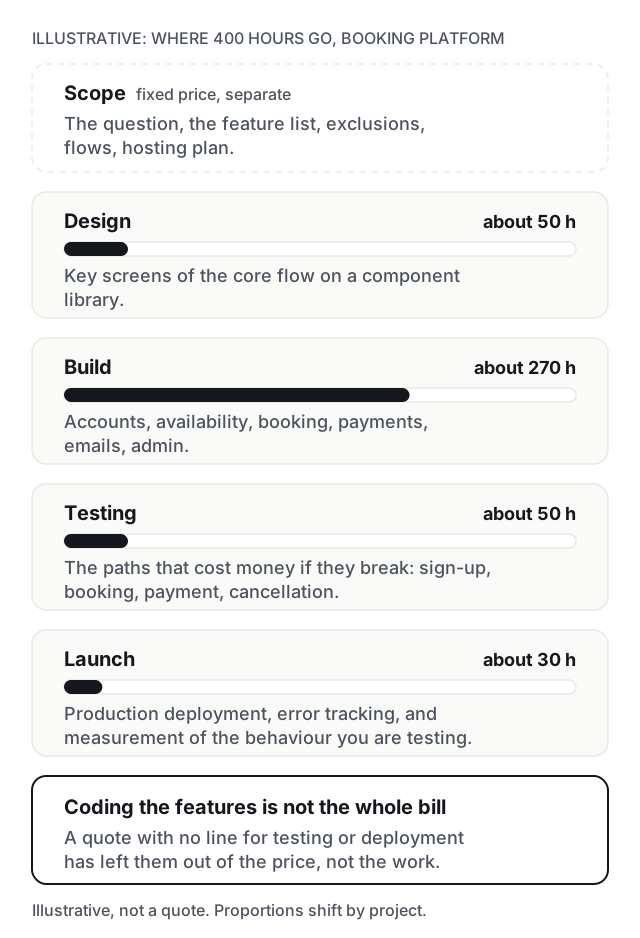
Taking Example 2, the 400-hour booking platform, an illustrative split by phase looks like this. The proportions shift with every project; the point is that coding the features is not the whole bill.
| Phase | Illustrative hours | What it covers |
|---|---|---|
| Scope | Fixed price, separate | The question, the feature list, exclusions, flows, hosting plan |
| Design | About 50 | Key screens of the core flow on a component library |
| Build | About 270 | Accounts, availability, booking, payments, emails, admin |
| Testing | About 50 | The paths that cost money if they break: sign-up, booking, payment, cancellation |
| Launch | About 30 | Production deployment, error tracking, measurement of the behaviour you are testing |
A quote that has no line for testing or deployment has not left them out of the work. It has left them out of the price.
A brief template for an accurate quote
Most of the spread between quotes comes from agencies guessing at different products. A one-page brief removes most of that guessing, and it is the document every agency, freelancer and grant application asks for in some form. Copy this, fill it in, and send the same version to everyone you ask.
| Section | What to write | Example |
|---|---|---|
| 1. The question | The one thing the MVP must find out | Will independent physiotherapists pay €29 a month to let patients book and pay online? |
| 2. What counts as a yes | The result that would make you build more | 20 paying physiotherapists within three months of launch |
| 3. Users | Each type of user, in one line each | Physiotherapists who are booked; patients who book; you, as admin |
| 4. The core flow | The steps from arrival to value, for the main user | Patient picks a physio, picks a slot, pays, gets a confirmation and a reminder |
| 5. Must have | The features without which the question cannot be answered | Provider availability, booking, card payment, email confirmations, cancellation rules |
| 6. Out of scope | What you are deliberately leaving out | Native apps, two-way calendar sync, SMS, reviews, multi-clinic accounts |
| 7. Integrations | Every outside system and whether it is essential | Stripe (essential); Google Calendar export (nice to have) |
| 8. Data and compliance | Personal or sensitive data, and where users are | Patient names and appointment times; users in Ireland and the UK |
| 9. Already built | Designs, a prototype, code, a domain, accounts | A Figma mock-up of three screens; a domain |
| 10. Platform | Web, mobile web, or native apps, and why | Responsive web only for version one |
| 11. Deadline | A real date and what depends on it | A pilot with two clinics starting in March |
| 12. Budget range | The range you can spend, honestly | €10,000 to €15,000 |
| 13. After launch | Who will run, fix and extend it | The agency for three months, then a hire |
Two rules make it work. Write section 6 as carefully as section 5, because exclusions are where quotes diverge. And give a budget range: it lets an agency tell you what fits rather than pricing the most expensive reading of your idea.
A brief is not yet a scope. The scope is the next step: a feature list tied to the question, the user flows step by step, the technical and hosting plan, and a fixed price and timeline. That is what our MVP Scoping Sprint produces: €900 fixed, about two weeks, written so another team could price and build from it, and credited in full against the build if you build with us.
Fixed price or time and materials?
Fixed price gives you a known number. It works when the scope is written and stable. The risk is that every change becomes a negotiation, and agencies price uncertainty into a fixed quote, so you pay for risk that may never happen.
Time and materials means you pay for the hours worked. It works when you expect to learn during the build and want room to change direction. The risk is that the total is not fixed, so it needs regular check-ins on hours spent and a cap you both agree.
What we do: scoping is a fixed price, the Scoping Sprint above, and you keep the written scope whatever you do next. The build is then quoted against that scope, and a new idea during the build is treated as a visible change to it, with its own price, rather than something absorbed silently.
Whichever model you choose, insist on two things: a written list of what is out of scope, and working software at the end of each stage, so you can see what you are paying for.
How to compare quotes
Put every quote in one table and check the same lines on each:
- Scope. Does it list the features, or only a total? Is there a list of exclusions?
- Phases. Are design, testing and deployment priced, or missing?
- Rate and hours. Can you see the hours behind the number, or only the number?
- Who builds it. Named roles, where they are, and who your contact is.
- Changes. How a new idea mid-build is priced and approved.
- Ownership. Code, accounts and designs in your name, and when.
- After launch. Bug fixing, a warranty period, and what support costs.
- Payment schedule. Tied to working software at each stage, not to dates alone.
If one quote is far lower than the rest, find the line it left out before you celebrate.
Running costs to budget for
The build price is not the cost of running the product. Plan for these from the start.
| Cost | When it starts | How it grows |
|---|---|---|
| Hosting, database, email, storage | At launch, sometimes before | With users and data |
| Third-party services: maps, SMS, search, AI models | At launch | Per use, so a successful launch raises the bill |
| Payment fees | First transaction | A percentage of revenue |
| App store accounts | Before a mobile release | Fixed yearly or one-off |
| Maintenance and fixes | From week one after launch | With the size of the product |
| Version two | When the MVP works | A new budget |
Hosting and infrastructure. Free tiers are fine for development but often not for a live product. Vercel's Hobby plan, for example, is restricted to non-commercial, personal use, and Supabase pauses free projects after a week of inactivity. Expect a monthly bill for hosting, a database, email sending and file storage, which grows with usage. Easify deploys client products to EU data-centre regions, and the scope sets out what hosting will cost to run.
Third-party services. Maps, SMS, AI model usage, search, analytics. Many charge per use. Model usage in an AI product in particular scales with every request; the AI MVP guide shows how to work out cost per task.
Payment fees. Stripe and similar providers take a fee on each transaction. Check Stripe's pricing for your country.
App store fees. The Apple Developer Program costs $99 a year, and a Google Play developer account has a one-off $25 registration fee. On top of that, both stores take a commission on paid apps and in-app purchases; Apple's Small Business Program reduces it to 15% for developers earning up to $1 million a year.
Maintenance. Dependencies need updates, security patches arrive, and users find bugs. Somebody has to own that, whether it is the agency, a freelancer or your own hire.
The second version. If the MVP works, you will want to build on it. That is the best possible outcome, and it is a new budget. An MVP built on proper foundations, with migrations and server-side authorisation, can be extended. One built as a throwaway demo often cannot.
Common mistakes that raise the cost
- Asking for quotes before writing a brief. Five agencies quote five different products, and the comparison tells you nothing.
- Choosing on the hourly rate alone. A lower rate with no design, testing or project management can cost more in total.
- Building native apps first. Two app codebases and store review, to test something a web app could test.
- Leaving payments until the end. Checkout, refunds and payouts touch everything; designing them in costs less than retrofitting them.
- Skipping testing to save budget. The bugs are found anyway, by your first users, at a worse moment.
- Spending the whole budget on version one. Keep some back for the changes the first users ask for. That is the point of an MVP.
- Ignoring running costs. A product that costs more to run than it earns is not validated, however good the launch.
How founders pay for it
Most MVPs in Europe are paid for with founders' savings, revenue from another business, or angel and pre-seed money. Public money can help, but it is specific to each country, often reimburses spending after the fact rather than paying in advance, and usually comes with rules about what counts and when the work may start. Read the rules before you sign a build contract, not after.
Our guide to MVP grants and funding in Europe goes country by country, and there are separate guides for EU-wide funding, Ireland's LEO grants, the UK, Germany, Austria, the Netherlands and Hungary. Whatever the source, the brief template above is a good start for the application: funders ask the same questions as agencies.
Easify invoices in euros from its registered entity in India. For EU and UK business clients, that means the supplier is outside your country and the reverse charge applies; confirm the treatment with your accountant, and check whether a grant scheme has rules about suppliers outside your country.
When we are not the right choice
- Your budget is under €1,000. That is our minimum project. A no-code tool or an AI app builder is a better place to start; see agency vs freelancer vs no-code.
- You need people on site every week. We work remotely across Europe. If your project needs someone in the room, hire locally.
- You already have a working prototype built with an AI tool. You may not need a new build at all. Our Prototype Check costs €99: within 48 hours a person reviews the repository and the live app and sends you the top security and data risks in writing. The €99 is credited against the build if you then build with us.
For every Easify band, not only MVPs, see pricing. For how the weeks break down, read how long it takes to build an MVP, and for choosing who builds it, the 12 questions to ask an MVP agency.
Work with us
Want a price for your MVP from the people who would build it?
We are a Budapest team that builds MVPs for founders across Europe, typically €4,000 to €25,000 over four to twelve weeks. Send us a few lines on what you want to test, who it is for and anything already built, and we reply within one business day.


Frequently asked