MVP Grants and Startup Funding in Europe, Country by Country

Public money for building an MVP exists in most European countries, but it rarely looks like the free grant founders hope for. On the rules as published on 20 October 2026, it is usually a loan, an equity investment, or a grant for part of the cost (often 50% to 70%), paid after you spend, and often with conditions about who may do the work and where. A handful of schemes fit an MVP build well; many more are closed, aimed at research, or built for established companies.
This hub summarises what we found in each country and links to the full guide. Each guide sets out the schemes from their official sources and answers the question most guides skip: can the money pay an outside development team, or one in another country? This is orientation, not financial or legal advice.
At a glance
| Country | Best realistic route for an MVP build | Type | Outside or foreign team? | Full guide |
|---|---|---|---|---|
| Ireland | Enterprise Ireland Pre-Seed Start Fund; LEO Feasibility and Priming grants | Convertible loan; partial grants | PSSF: overseas contractors explicitly allowed. LEO: outside teams allowed; some offices require VAT-registered suppliers | LEO grants, Enterprise Ireland |
| United Kingdom | Money raised under SEIS or EIS; a Start Up Loan up to £25,000 | Equity with investor tax relief; personal loan | SEIS and EIS set no supplier-location rule; R&D relief excludes most overseas contractor costs | UK funding |
| Germany | KfW start-up loans; Länder grants such as Berlin's GründungsBONUS Plus; EXIST for research teams | Loans; partial grants | Berlin names IT development as eligible; Bavaria's BayTOU wants the work done substantially in Bavaria | Germany funding |
| Austria | aws Preseed (Innovative Solutions or Deep Tech); FFG Kleinprojekt | Grants for part of the cost | Third-party IT services eligible, but value creation must be mainly in Austria; Forschungsprämie needs an EU or EEA contractor | Austria funding |
| Netherlands | Vroegefasefinanciering (VFF); regional proof-of-concept loans | Loans | VFF silent; Innovatiekrediet caps outflow abroad at 50%; WBSO excludes outsourced work | Netherlands funding |
| Hungary | Hiventures early-stage fund; DIMOP Plusz digital startup fund | Equity | Money must be used at the Hungarian site; no supplier-location rule stated | Hungary funding |
| Spain | ENISA participative loans | Loan, matched by own funds | ENISA silent; Kit Digital (closed) only paid EU-based registered agents | Spain funding |
| France | Bourse French Tech (up to €30,000); prêts d'honneur | Grant for part of the cost; personal loans | BFT silent on location; CIR and JEI exclude non-EU subcontractors | France funding |
| Italy | Smart&Start Italia | Zero-interest loan, part grant in the South | Third-party software development eligible; turnkey contracts excluded | Italy funding |
| Portugal | None open for founders today | Portugal funding | ||
| Poland | PARP Platformy startowe (Eastern Poland) | Grants | External services eligible; competitive procedure above 80,000 zł | Poland funding |
| EU-wide | EIC Accelerator, only for validated deep tech | Grant and equity | Subcontracting allowed only where justified; some calls restrict countries | EU funding |
If you were looking for Ireland's Trading Online Voucher for a website or online shop, it closed in December 2024; its replacement, Grow Digital, is explained here.
The honest summary
Few schemes pay for a simple MVP. In Portugal nothing aimed at founders is open today, in Hungary the open money is equity rather than grants, and in the Netherlands it is loans and tax reductions. EU-level programmes are built for deep tech that needs millions. If your product is a straightforward web or mobile app, expect to fund most of it yourself or from investors, and treat public money as a contribution rather than the plan.
The schemes that fit well have conditions. Ireland's Pre-Seed Start Fund and Italy's Smart&Start are the clearest fits we found, and both still expect you to put in money of your own and meet eligibility rules on company stage, location and innovation.
Partial grants pay after you spend. Ireland's LEO grants, Austria's aws Preseed and France's Bourse French Tech cover part of the cost, typically reimbursed against invoices. You need the cash to pay the developer first.
The rules that catch an outsourced build
Most founders who hire an outside team for their MVP run into one of these. Each is set out with its source on the country page.
| Rule | Where we found it | What it means for you |
|---|---|---|
| Apply before you spend | Ireland LEO, France Bourse French Tech, Berlin GründungsBONUS Plus, KfW loans | Do not sign a development contract or pay a deposit before the application is in, or the cost may not count |
| Supplier must be in the EU or EEA | France CIR and JEI, Austria Forschungsprämie; the UK's R&D relief excludes most overseas work | A team invoicing from outside the EU, including ours from India, does not count for these tax incentives |
| Work or value creation must be in the country | Austria aws and FFG, Vienna, Bavaria BayTOU, Hungary's Hiventures and DIMOP funds | A mainly outsourced build may score lower or be ineligible; ask how the programme treats it |
| No turnkey contracts | Italy Smart&Start | A single fixed-price "deliver the whole product" contract may be excluded; structure the work as defined services |
| Supplier must be VAT-registered | LEO Dublin City | An invoice from outside the EU under the reverse charge carries no Irish VAT, so ask whether it is accepted |
| Several quotes above a threshold | Ireland (some LEOs), Austria FFG, Spain Neotec, Poland | Get comparable quotes early; a written scope makes them comparable |
| Outsourced R&D excluded | Netherlands WBSO | Only your own staff's hours count |
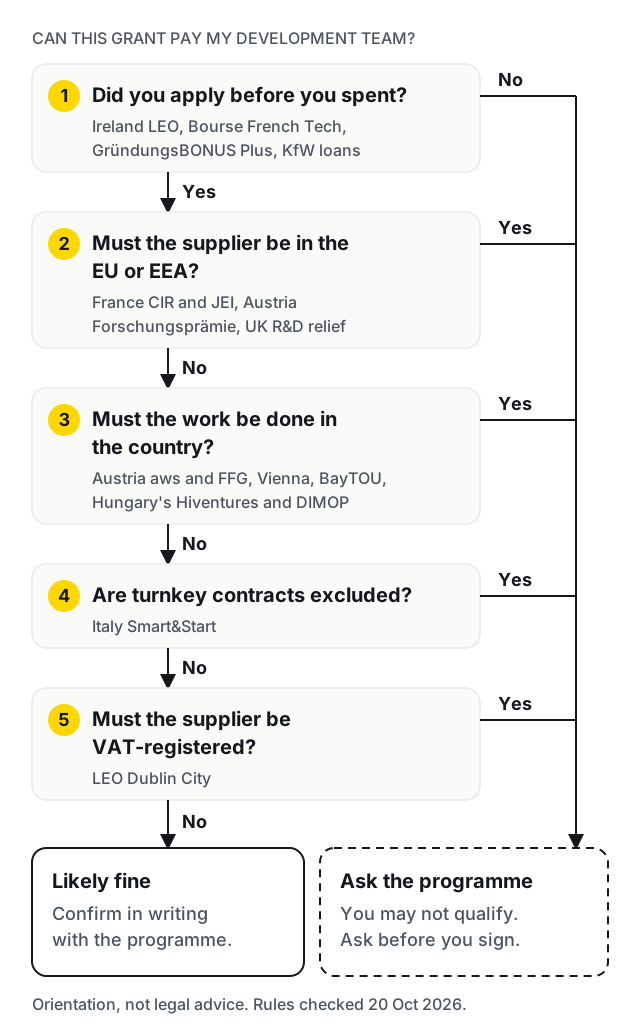
None of these rules is about Easify specifically. We include them because a founder who learns them after signing a contract can lose the funding, and because it is better to know before you choose any supplier.
How to plan your MVP budget around funding
- Read the scheme's eligible-cost and supplier rules first, then ask the programme in writing whether the team you have in mind qualifies. Our country pages name who to ask.
- Get a written scope and a fixed price before you apply. Many applications ask for quotes or a project plan, and a vague estimate is hard to fund. Our €900 MVP Scoping Sprint produces a written scope, a fixed build price and a timeline in about two weeks, and the €900 is credited in full against the build if you build with us. No scheme requires or endorses our document; it is simply the kind of evidence that helps.
- Time the contract after the application, for any scheme that requires it.
- Plan the cash flow for partial grants paid in arrears.
- Budget the whole build, not only the funded share. Most MVPs we build come to €5,000 to €25,000 over four to twelve weeks; the MVP cost calculator gives a rough range for your scope, and what an MVP costs in Europe compares it with local agency prices.
One of our clients in Ireland is using Local Enterprise Office support towards the MVP we are building with them now.
Where Easify fits, and where it may not
We are based in Budapest, with engineering in India, and we host client products in the EU. Invoices are in euros from our registered entity in India. That makes us a supplier outside the EU for tax purposes, which matters for the schemes in the table above that require an EU or EEA supplier or work done in the country. For those, we are the wrong choice, and we would rather say so now. For schemes that allow outside or overseas contractors, or that fund the company rather than specific suppliers (equity, most loans), the question does not arise.
If you are not sure which applies to you, ask the programme first, then talk to us about the build.
Scheme details checked against official sources on 20 October 2026. Schemes change; confirm with the programme before applying.
From Budapest, for teams in Europe
Applying for funding and need a written scope and a fixed price to put in it?
Many grant and loan applications ask for quotes and a project plan. Our €900 MVP Scoping Sprint gives you a written scope, a fixed build price and a timeline in about two weeks, credited in full if you build with us. Check your scheme's supplier rules first, and we reply within one business day.


Frequently asked