How to Choose an MVP Development Agency: 12 Questions to Ask

To choose an MVP development agency, ask every agency on your shortlist the same twelve questions, in writing, and compare the answers rather than the prices. The questions that separate good agencies from the rest are what they would cut from your version one, who actually writes the code, what the quote leaves out, and who owns everything at the end. Below are the twelve, with Easify's own answer to each so you can see what a direct answer looks like, followed by a scorecard to compare agencies, how to check references, what the contract must say, and the red flags that should end a conversation.
At a glance
| What to compare | Answers to the same questions, not headline prices |
| Most revealing question | What would you leave out of version one? |
| Must be in writing | Scope, exclusions, price model, ownership, data processing |
| Biggest red flag | A price before they understand what you are testing |
| Safest first step | A small, fixed-price scoping stage before the full build |
| Easify, for reference | €4,000 to €25,000, 4 to 12 weeks, €25 to €45 an hour |
| Easify, location | Budapest, CET, English or Hungarian; engineering team in India |
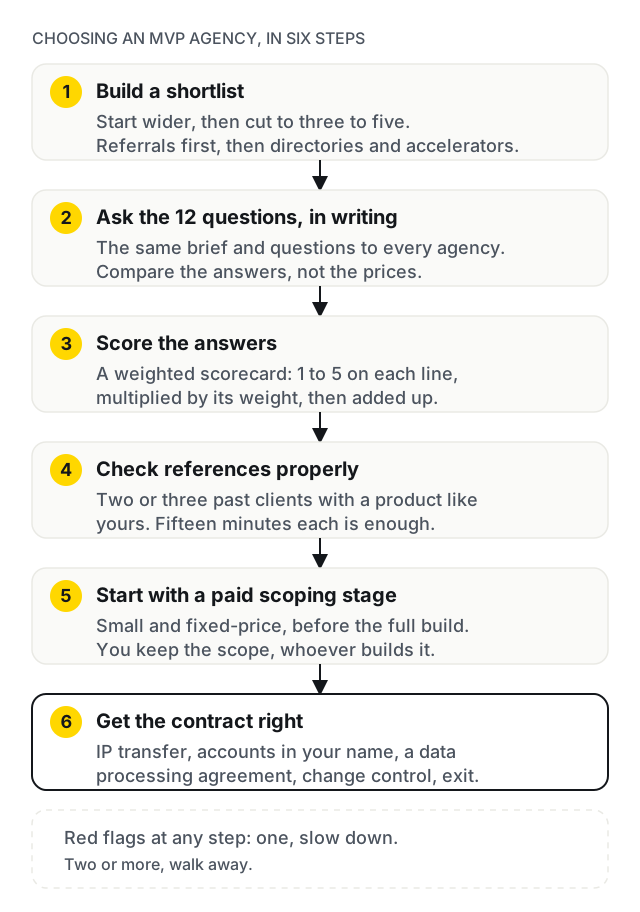
Step 1: build a shortlist
Start wider than you need and cut to three to five agencies. Common places to look:
- Referrals from founders who have shipped something similar. The most useful source, because you can ask what went wrong.
- Review directories such as Clutch, GoodFirms and TechBehemoths. Read how reviews are checked: Clutch, for example, says it verifies reviews using reviewer-provided information and online research, and publishes reviews it cannot verify marked as not verified. A verified review is a stronger signal than a testimonial on the agency's own site.
- Accelerators, incubators and grant bodies, which often keep lists of suppliers their founders have used.
- Agencies whose own products or case studies look like what you want to build.
For the region, our comparison of MVP agencies in Central and Eastern Europe lists firms alphabetically with checked facts.
Cut anyone who cannot show work close to your product type, will not say who builds it, or will not give a price range before detailed scoping.
Step 2: ask the 12 questions, in writing
Send the same short brief to each: what you want to test, who it is for, any deadline, anything already built. Our MVP cost guide has a brief template. Then send these twelve questions.
1. What question will this MVP answer?
A good agency asks this before it talks about features or technology. If it cannot restate what you are trying to learn, it is quoting a product, not an experiment.
Our answer: this is where every MVP with us starts. We agree what you want to find out and what result would change your plans, and that decides the scope.
2. What would you leave out of version one?
The most revealing question on the list. An agency paid by the hour has no obvious reason to argue for less work, so the ones that do are telling you something.
Our answer: we will argue for cutting admin panels, settings pages, tiered permissions and onboarding flows, and explain why. The decision stays yours, and we write the exclusions down.
3. Who will actually write the code, and where are they?
Many agencies subcontract or split teams across countries. That is not a problem in itself; not knowing is.
Our answer: the people you talk to are in Budapest, and the engineering team is in India. We say so up front because you should know it before you sign, not discover it later.
4. Who do I talk to, in what language and time zone?
You need one named person who knows the project, replies quickly, and is awake during your working day.
Our answer: your contacts work on CET, in English or Hungarian, and we work remotely across Europe. If you need someone in your meeting room every week, hire locally.
5. How is it priced, and what is the range?
Ask for the pricing model, the rate, and a range for something like your project, before any detailed scoping.
Our answer: €25 to €45 an hour, with a €1,000 minimum project. MVPs typically land between €4,000 and €25,000. Scoping is a fixed-price MVP Scoping Sprint: €900, about two weeks, credited in full against the build if you build with us. The build is quoted against the written scope. Our pricing page shows every band, and the MVP cost guide explains what moves the number. We invoice in euros, from our registered entity in India.
6. What is not included in the price?
Every quote excludes something. The good ones say what.
Our answer: hosting and third-party service costs, marketing and paid acquisition, features that do not change the answer to the question, and a second direction once the first is built, which is a new scope.
7. How often will I see working software?
Monthly status reports are not the same as something you can click.
Our answer: something usable at the end of each stage, so you react to software rather than a plan. Clients can follow progress in a shared project management tool; Mary Grace Gasco, a CEO we worked with, named that visibility in her review.
8. Who owns the code, the accounts and the designs, and when?
Ask specifically about the code repository, the hosting account, the domain, the payment provider and the design files. They should be in your name or transferred to you. See the contract section below for why this has to be written down.
Our answer: the code, accounts, design files and documentation are yours on final payment. Taking the product in house after launch is a good outcome, and we document it so another team can.
9. How do you handle security and data?
An MVP still holds real users' data and, often, real money. Ask where authorisation is checked, how database changes are managed, where secrets are kept, and where the product will be hosted.
Our answer: authorisation is checked on the server, database changes go through version-controlled migrations, and the deploy is a real pipeline. These are the same foundations we use on any project. Client products are deployed to EU data-centre regions.
10. What happens if the MVP works?
The quiet failure of many MVPs is success: the product finds users and then has to be rebuilt because it was built as a demo.
Our answer: we build so it can be kept. It costs a little more in the first weeks and it is the difference between growing the product and starting again.
11. Can I see work like mine, and talk to the client?
Ask for case studies close to your product type, and what the agency actually did on each.
Our answer: our published case studies include Nonstop Nanny, a babysitter booking platform in Budapest we took from concept to MVP with secure online payment, and Easify AI, an AI database-querying product we took from idea to a working MVP. We take on any industry, including fintech and healthtech, but we have no published case studies in those sectors, and we will not pretend otherwise. Ask us which project is closest to your idea and what we would do differently now.
12. What happens after launch?
Who fixes bugs, who updates dependencies, and what does it cost? Is there a handover if you want to move on?
Our answer: you can take it in house with documentation good enough for another team, or keep working with us, agreed separately. Whichever you choose, it should be a decision rather than a dependency.
Step 3: score the answers
Put the written answers in one table. A simple weighted scorecard stops the comparison collapsing into price alone. Score each agency from 1 to 5 on each line, multiply by the weight, and add up.
| Criterion | Weight | What a 5 looks like | What a 1 looks like |
|---|---|---|---|
| Scoping and cuts | 3 | Restates your question, proposes specific cuts with reasons | Lists every feature you mentioned, adds more |
| Transparency on team | 2 | Names roles, locations and your contact | "Our team", nothing more |
| Price clarity | 3 | Range, rate, hours, exclusions and change rules in writing | A single total with no breakdown |
| Delivery rhythm | 2 | Working software at the end of each stage | A demo at the end |
| Ownership and exit | 3 | Code, accounts and designs in your name, handover documented | Code in their accounts, ownership "after the project" |
| Engineering foundations | 2 | Server-side authorisation, migrations, tests, a deploy pipeline | No mention, or "we will add that later" |
| Relevant work | 2 | Case studies close to your product, with clients you can call | Generic portfolio, no references |
| Fit and communication | 1 | Replies quickly, in your language and working hours | Slow, vague or always through a salesperson |
The weights are a starting point; change them to suit you. If security matters more than speed for your product, weight it higher. What matters is that every agency is scored on the same lines.
Step 4: check references properly
Ask each finalist for two or three past clients with a product like yours, and call them. Fifteen minutes each is enough. Ask:
- What did the agency suggest cutting, and were they right?
- Did the final price match the quote? If not, why?
- How were changes handled during the build?
- How quickly did they reply when something went wrong?
- Did you get working software at each stage, or only at the end?
- Is the code and every account in your name now?
- What happened after launch: bugs, handover, ongoing work?
- Would you hire them again for the next version?
The answer to the last question, and how long the person hesitates before giving it, tells you most of what you need.
Step 5: start with a paid scoping stage
A small, fixed-price first step shows you how an agency works before you commit the whole budget. You see how they ask questions, how they handle your ideas, and how clear their writing is. At the end you have a scope, which you can take to another agency if the first one did not convince you.
Our version is the MVP Scoping Sprint: €900, about two weeks, a written scope with a fixed build price, written so another team could price and build from it. It is credited in full against the build if you build with us. If you already have a prototype from an AI app builder, the €99 Prototype Check is a smaller first step, also credited against the build.
Step 6: get the contract right
Read the contract as carefully as the quote. These clauses do the most work:
- Transfer of intellectual property. Under EU law, when an employee writes software in the course of their duties, the employer is entitled to exercise the economic rights in it unless a contract says otherwise (Software Directive 2009/24/EC, Article 2(3)). An agency is not your employee, so that default does not help you. The contract should transfer the code, designs and documentation to your company, and say when (typically on payment).
- Accounts in your name. The code repository, hosting, domain, payment provider, app store accounts and analytics, created in your name or transferred before launch.
- Data processing agreement. If the agency will handle your users' personal data, for example by running your hosting or seeing production data during support, it is acting as your processor. The GDPR requires that relationship to be governed by a contract that sets out the subject matter, duration, nature and purpose of the processing (Article 28).
- Scope and change control. The written scope attached, the exclusions listed, and how a change is priced and approved.
- Payment schedule. Tied to working software at each stage rather than to dates alone.
- Warranty and support. How long bugs in delivered work are fixed at no extra cost, and what support costs after that.
- Confidentiality. Covering your idea, your data and anything you share during scoping.
- Exit. What happens if either side ends the contract early: what you receive, in what state, and what you owe.
This is general information, not legal advice. For a large or unusual contract, pay a lawyer for an hour.
Red flags
Any one of these is a reason to slow down. Two or more, walk away.
- A fixed price in the first call, before anyone understands what you are testing.
- Yes to every feature. An agency that never pushes back is not thinking about your budget.
- No written exclusions. If nothing is out of scope, every disagreement later is about money.
- The code lives in their accounts, with ownership "after the project", undefined.
- Nothing to see until the end. Weeks of updates and no working software.
- Vague about who builds it. "Our team" with no detail on where or who.
- No mention of security, testing or deployment in the proposal.
- Pressure to sign quickly, with a discount that expires.
- Promises about outcomes, such as users, revenue or investment. Nobody building your MVP can promise those.
- Sector experience with nothing behind it. A claim to have built "dozens of fintech products" with no case study, client or reference to check.
- A timeline far shorter than everyone else's, for the same scope, with no explanation of what was cut.
Common mistakes founders make when choosing
- Comparing headline prices of quotes that describe different products.
- Talking only to salespeople, never to the person who will lead the build.
- Skipping reference calls because the portfolio looked good.
- Signing for the whole build at once, without a smaller first stage.
- Leaving ownership to "standard terms" instead of reading them.
- Choosing the agency that agreed with everything, because it felt like the easiest relationship.
When an agency is not the right choice
- Your budget is under €1,000, or you need to test demand in days. Start with no-code, an AI app builder or a landing page. Our comparison of agencies, freelancers, no-code and co-founders goes through when each is right.
- The build is narrow and you can manage it yourself. A strong freelancer may be cheaper and perfectly good.
- You already have an AI-built prototype. You may need hardening, not a new build. Our Prototype Check costs €99 and is credited against the build if you hire us.
If you want to see how we run an MVP end to end, read the MVP development page; for how long it takes, see how long it takes to build an MVP.
Work with us
Want our answers to these questions for your MVP specifically?
We are a Budapest team that builds MVPs for founders across Europe, typically €4,000 to €25,000 over four to twelve weeks. Send us the questions you are asking every agency, plus a few lines on what you want to test, and we reply within one business day.


Frequently asked