MVP Development
MVP development for startups. We build the smallest version of your product that real users will pay for, usually in 4 to 12 weeks.

At a glance
| Typical price | From €4,000, fixed after a written scope; most stay under €25,000. Rate €25 to €45 an hour, €1,000 minimum. Estimate yours |
| First step | The MVP Scoping Sprint: about two weeks, €900 fixed and credited in full against the build. You get a written scope and a fixed price |
| Typical timeline | 4 to 12 weeks from signed scope to live product |
| Included | Testing, security, payments and 30 days of bug fixes after launch, in every MVP |
| What you get | A working web or mobile product with real users, the code and accounts in your name, and a written summary of what your first users taught you |
| Stack | Next.js, React, TypeScript, Laravel, PostgreSQL, Stripe, Vercel |
| Hosting | In the EU. We deploy client products to EU data centres |
| Industries | Any, including regulated ones such as fintech and healthtech |
| Team | Working remotely with clients across Europe, in English or Hungarian |
| Built before | A babysitter booking platform, an AI database-querying SaaS, a marketplace for digital businesses, a home-services SaaS |
| Already have an AI-built prototype? | Start with the €99 Prototype Check |
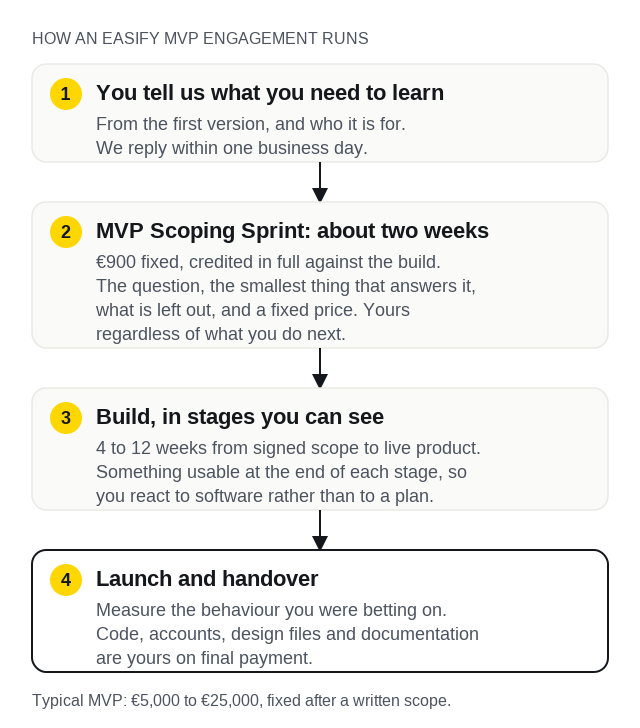
| To start | Tell us what you need to learn from the first version and who it's for. We reply within one business day |
What an MVP is for
MVP development is about finding out whether people want your product before you spend your whole budget finding out.
Most first versions we're asked to quote are the whole product on a smaller budget. So our first conversation is usually about what to remove. It can sound like we're talking you out of work. It's the most useful hour of the project.
Start with one question
Before scope, design or code, we ask: what do you need to learn, and what result would change what you do next?
"Will restaurant owners pay monthly for automated rota scheduling?" is a question. It tells us the MVP needs rota building, a way to invite staff and a subscription. It also tells us you don't need reporting, integrations or a settings page, because none of those change the answer.
"Build a restaurant management platform" gives us nothing to test. A project scoped from it will run for a year.
How we work
Weeks one and two: scope. We agree the question, the smallest product that answers it, and what we're leaving out. You get it in writing with a fixed price, and it's yours whatever you do next. This is the €900 Scoping Sprint, and you can book it on its own.
Then we build, in stages you can see. You get something usable at the end of each stage, so you're reacting to working software. It's also where we catch scope creep, because a new idea shows up as a change to something real.
Launch, then measure what we agreed to measure. We track whether the specific behaviour you're betting on actually happens.
What you will own
The code, the accounts, the design files, and documentation good enough for another team to pick it up. It's all yours on final payment. Some clients have taken their MVP in house after launch, and that's a perfectly good outcome.
The odds
Most MVPs don't become businesses. That's what testing an idea means. A well-scoped MVP that gives you a clear no has done its job, for a fraction of what it would cost to find out later.
We'd rather you spent a little on a clear answer than a lot on a hopeful one.
Guides for founders
- How much does an MVP cost in Europe?, or estimate yours
- How long does it take to build an MVP?
- How to choose an MVP development agency: 12 questions
- Agency, freelancer, no-code or a technical co-founder?
- Grants and public funding for an MVP, country by country
- By product: marketplace, booking platform, AI product, SaaS
How it works
- Start with one question
- Before we build anything, we agree what you want to find out, and which answer would change your plans. That question sets the scope. It's the best way we know to keep an MVP small.
- Leave most things out
- Founders often want a feature in version one because a competitor has it. Admin panels, settings pages, user roles and onboarding flows can almost always wait. We'll tell you what we would cut and why. You make the call.
- Real enough to charge for
- Working payments, real accounts, saved data. People behave differently once a card is involved, and that's the signal worth getting. A prototype that can't take money tells you much less.
- Built to keep if it works
- The failure we see most is an MVP that finds its market and then gets thrown away, because it was built as a demo. We build yours on the same foundations as any other project: version-controlled migrations, server-side authorisation and a proper deploy. It costs a little more in week one, and it means you can grow it instead of starting again.
- Live in weeks, then you decide
- A typical MVP takes four to twelve weeks, depending on scope. At the end you have a live product, real usage data and a written summary of what we learned. Then you decide whether to build on it, change direction or stop. Stopping now costs far less than stopping a year from now.


What's included
Included
- A written scope naming the one question the MVP answers
- A list of what we're leaving out, and why
- Working payments, real accounts and saved data
- The same foundations as any other build, so you can keep it
- Something you can use at the end of each stage
- Tracking of the one behaviour you're betting on
Not included
- Features that don't change the answer to your question
- Marketing, launch and paid ads
- Ongoing hosting and third-party service costs
- A second direction after the first is built (that's a new scope)
What we build with
- Next.js
- React
- Laravel
- PostgreSQL
- Stripe
- TypeScript
- Vercel
What does an MVP cost?
How long does it take?
What should be in version one?
Will it survive if it works?
Do we own it?
What if the answer is no?
Related articles
- Healthtech MVP Development: Health Data, MDR and Scope
- HR Tech MVP Development: Recruiting, GDPR and the AI Act
- Fintech MVP Development: Licences, Partners and Scope
- MVP Development Companies in Central and Eastern Europe Compared
- Edtech MVP Development: Buyers, Children's Data and Scope
- Proptech MVP Development: Listings, Bookings and Payments
Tell us about your project.
Get in touch ↗